

Digital Rights Management for Tokenized Art Explained
Digital Rights Management (DRM) is reshaping how digital and tokenized art is sold and owned. By embedding ownership rules and usage licenses directly into blockchain-based tokens, DRM ensures artists maintain control, automate royalties, and protect their work from misuse. Collectors benefit from verified ownership, clear usage rights, and secure access to high-quality files.
Here’s how DRM works for tokenized art:
- Smart Contracts: Automate royalties (0–50%) and enforce usage rules.
- Decentralized Storage: High-quality files are stored securely on IPFS.
- Metadata: Artist and artwork details are embedded directly into tokens.
- Anti-Speculation Tools: Features like resale timers maintain long-term value.
- Stablecoin Payments: Transactions in USDC reduce crypto volatility risks.
Solutions like Digital Original simplify this process, offering no-code storefronts, instant payouts, and compliance with global regulations. While DRM provides clear benefits, challenges like technical barriers and legal complexities remain. Artists and collectors can navigate these with tools like automated licenses, stable pricing, and decentralized systems.
Key takeaway: DRM combines blockchain, smart contracts, and decentralized storage to protect artists' rights and offer collectors secure, transparent ownership of tokenized art.
NFT Revolution: How Blockchain is Changing Digital Ownership in art & beyond (Non-fungible Tokens)
How DRM Works in Tokenized Art
How DRM Works in Tokenized Art: 5 Core Components and Technologies
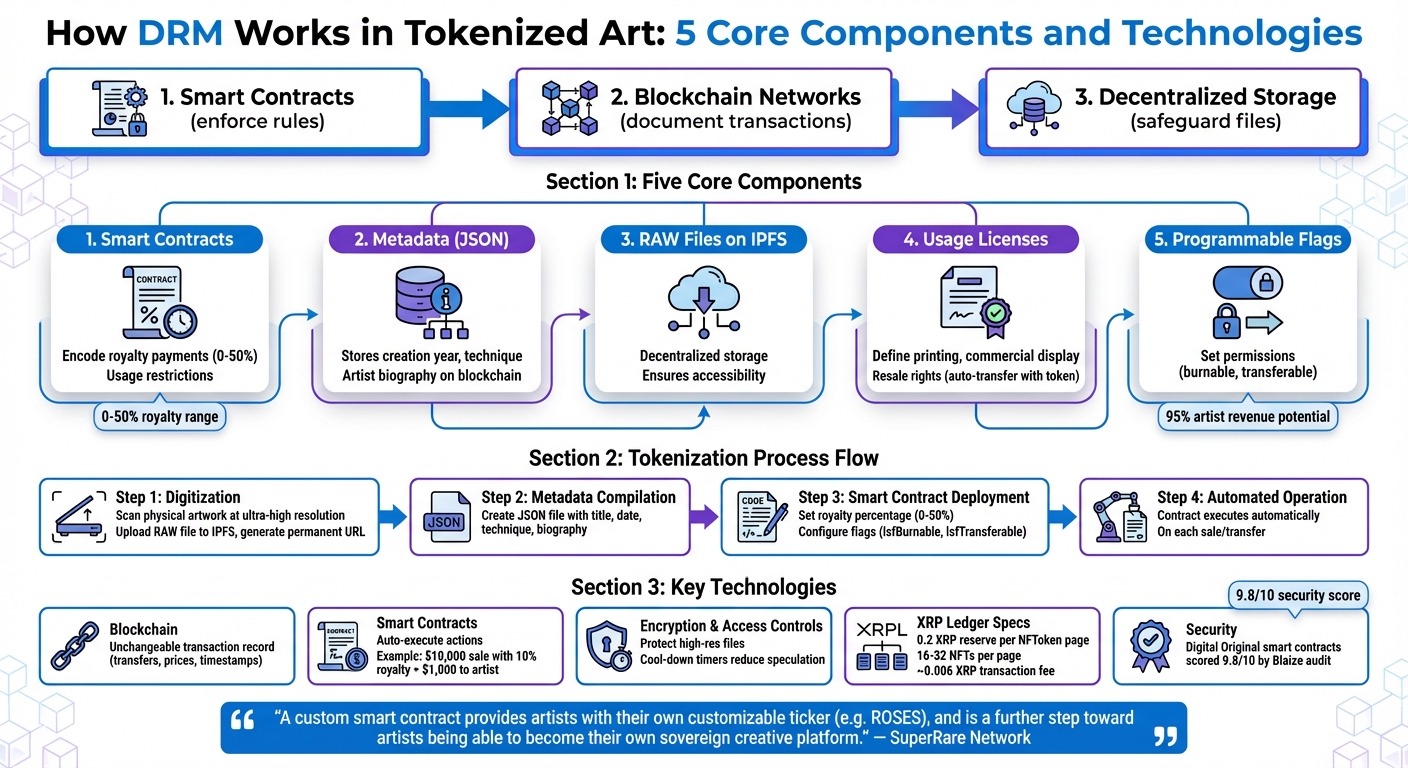
Digital rights management (DRM) for tokenized art operates through three tightly connected layers: smart contracts that enforce rules, blockchain networks that document transactions, and decentralized storage systems that safeguard the actual files. Each layer plays a critical role, working together to create a self-operating system that benefits both artists and collectors. Let’s break down these layers and their roles in bringing this DRM system to life.
Core Components of DRM Systems
A robust DRM system for tokenized art relies on five key elements working in harmony. At its heart are smart contracts, which encode rules for royalty payments and usage restrictions every time a token is transferred. Metadata in JSON format acts as the digital fingerprint of the artwork, storing details like the year of creation, artistic technique, and the artist's biography directly on the blockchain.
High-quality RAW files of the artwork are stored on IPFS - a decentralized file system that ensures these files remain accessible even if individual servers go offline. Usage licenses define what buyers can do with the artwork, such as printing it, displaying it commercially, or reselling it. These licenses are automatically transferred alongside the token via the smart contract. Lastly, programmable flags allow artists to set specific permissions, such as enabling a token to be burned (destroyed after one use) or restricting its transferability.
| Component | Function | Technology Used |
|---|---|---|
| Asset Storage | Stores RAW files | IPFS |
| Rights Enforcement | Automates royalties and transfers | Smart Contracts |
| Provenance | Tracks ownership and history | Blockchain Ledger |
| Metadata | Stores artist and artwork details | JSON / On-chain Hashing |
| Access Control | Manages visibility and resale | Anti-speculation timers / Flags |
Tokenization Process with DRM
When an artist tokenizes their work, DRM becomes an integral part of the process. It starts with digitization - physical artworks are scanned at ultra-high resolution, and the resulting RAW file is uploaded to IPFS. This generates a permanent URL that ensures the file remains accessible.
Next, artists compile essential details like the title, creation date, technique, and biography into a JSON file, which is embedded into the token. A smart contract is then deployed to automate royalties and permissions. For example, on the XRP Ledger, artists can set a transfer fee (or royalty percentage) ranging from 0% to 50% of future sales. They also configure flags, such as lsfBurnable for tokens that can be destroyed or lsfTransferable for tokens that can be resold. Once the smart contract is live, it operates automatically.
Technologies Behind DRM
Blockchain networks form the backbone of the system by creating an unchangeable record of every transaction. This includes details like transfers, sale prices, and timestamps, addressing longstanding issues of provenance in the art world.
Smart contracts enforce rules by executing actions when specific conditions are met. For instance, if a collector resells a piece for $10,000 with a 10% royalty set by the artist, the contract automatically transfers $1,000 to the artist’s wallet.
Encryption and access controls protect the high-resolution files. Artists can limit access to private audiences or use cool-down timers to delay resales, which can help reduce speculation and maintain the artwork’s long-term value.
On the XRP Ledger, each NFToken page requires a reserve of 0.2 XRP and can store between 16 to 32 NFTs. Transaction fees are minimal, averaging about 0.006 XRP, making the system accessible even for emerging artists. Additionally, Digital Original's smart contracts have been thoroughly vetted, earning a security audit score of 9.8 out of 10 from Blaize.
These interconnected technologies not only empower artists to maintain control and earn royalties but also give collectors the assurance of verified authenticity and a transparent ownership history.
Benefits and Challenges of DRM
Key Benefits for Artists and Collectors
Digital rights management (DRM) brings several advantages to the world of tokenized art, especially for artists and collectors. For artists, it simplifies earnings through automated royalties, ensures verified authenticity, and lowers costs. For example, creators using the Digital Original solution keep a hefty 95% of each sale. Even better, smart contracts take care of royalty payments on resales, eliminating the need for manual tracking. Artists working on the XRP Ledger can also customize transfer fees, choosing percentages anywhere between 0% and 50%.
Collectors reap the rewards of transparent ownership thanks to blockchain technology. Every transaction is recorded, making it easy to verify the history of a piece. Features like access controls allow artists to decide who can view high-resolution files, while tools like cool-down timers discourage quick flipping, helping maintain long-term value. Tokenization also cuts down on the logistical costs of physical art, such as storage and transportation.
While the benefits are clear, implementing DRM comes with its own set of challenges that artists need to address.
Implementation Challenges
One major hurdle is the technical expertise required. Many artists lack coding skills, but the rise of no-code platforms has made it easier for creators to launch their own storefronts without touching a single line of code.
Another challenge is crypto volatility, which can lead to unpredictable earnings if artwork is priced in unstable cryptocurrencies. By using stablecoins like USDC, artists can ensure dollar-based pricing, reducing financial risks.
Legal compliance is another tricky area, especially for international sales. Different countries have varying regulations for digital assets, making it challenging for artists to navigate the global market. Platforms that adhere to MiCA (Markets in Crypto-Assets) guidelines offer a more straightforward way to handle these legal complexities.
Lastly, enforcing usage rights for phygital artworks (a blend of physical and digital art) can be complicated. Traditional NFTs often leave collectors guessing about permissions - can they print the artwork? Use it commercially? Modify it? DRM systems solve this by embedding clear licensing terms directly into the token, ensuring these rights transfer seamlessly with ownership.
DRM Features Comparison Table
| Feature | Artist Benefit | Collector Benefit |
|---|---|---|
| Smart Contracts | Automated royalty payments on resales | Clear, enforceable resale rights |
| On-Chain Metadata | Proof of creation and provenance | Verified authenticity of the work |
| Access Controls | Control over high-res file visibility | Exclusive access to premium content |
| Physical Art Verification | Preservation of physical art integrity | Ownership of ultra-high-resolution assets |
| USDC Payouts | Protection against crypto volatility | Stable pricing for acquisitions |
Digital Original has already attracted over 140 artists, collectively representing an art portfolio worth more than $50 million. The platform charges a 5–15% fee on successful sales, with no upfront costs for artists.
sbb-itb-4e84554
Legal Considerations and Best Practices
U.S. Legal Framework for DRM
In the United States, digital art rights management operates at the intersection of intellectual property laws, smart contract rules, and crypto-asset regulations. Artists automatically retain full copyright ownership of their creations unless they explicitly transfer those rights in writing. It's important to note that owning an NFT does not mean owning the copyright to the underlying work - it simply represents ownership of a specific digital token or asset.
Smart contracts are becoming widely accepted as legally binding agreements, particularly when they automate royalty payments and usage restrictions. To avoid disputes, artists should embed usage licenses directly into the token metadata, clearly defining what collectors are allowed to do with the artwork. These licenses transfer automatically with each sale, creating a transparent and enforceable record of rights and restrictions.
On the international stage, the EU's Markets in Crypto-Assets (MiCA) Regulation has emerged as a key framework for ensuring legal clarity in digital asset transactions. Platforms aligned with MiCA compliance offer collectors verified provenance and legal certainty across borders. For added reliability, artists are advised to work with platforms that utilize audited smart contracts - such as those vetted by firms like Blaize - to ensure both technical soundness and legal enforceability.
This legal groundwork is essential for navigating the complexities of international transactions.
Cross-Border Legal Issues
Selling tokenized art internationally brings challenges like differing legal jurisdictions, tax regulations, and conflicting intellectual property laws. For instance, a collector in Japan may operate under copyright rules that differ significantly from those in Germany or the United States. Traditional art sales often require thorough international due diligence, complex shipping logistics, and dealing with fluctuating currency exchange rates.
Blockchain-based DRM simplifies many of these issues. By storing all artist-provided information on-chain, it creates an unchangeable record that transcends geographic boundaries. Using stablecoins like USDC for transactions helps avoid cryptocurrency price swings, providing instant, stable payouts through audited smart contracts.
Decentralized storage systems like IPFS further enhance reliability by ensuring that high-resolution artwork files remain accessible, even in the face of regional censorship or third-party disruptions. This approach protects both artists and collectors from risks like single-point failures that could jeopardize the availability of the artwork.
Best Practices for Compliance
To navigate these legal and technical challenges, consider the following steps to ensure compliance:
- Define your terms of use and pricing structure upfront. Embed detailed usage licenses into the token metadata to clarify ownership rights, reproduction limits, and commercial use restrictions.
- Set royalty percentages during the minting process. Most platforms allow royalties ranging from 0% to 50% of the sale price, ensuring you receive fair compensation for secondary sales.
- Incorporate anti-speculation measures. Features like cool-down periods discourage rapid flipping, helping to protect the long-term market value of your artwork.
-
Use token flags for added control. Flags like
lsfBurnableortransferableallow you to manage whether tokens can be destroyed or transferred, giving you greater control over the asset's lifecycle. - Store original files using decentralized systems. This ensures resilience against cyberattacks or platform failures.
| Compliance Feature | Purpose | Implementation |
|---|---|---|
| Usage License | Defines rights and restrictions | Encoded in token metadata |
| Transfer Fee | Automates artist royalties (0-50%) | Smart contract parameter |
| Anti-Speculation Timer | Protects long-term value | Cool-down smart contract |
| MiCA Compliance | Ensures regulatory transparency | Platform-level framework |
| IPFS Storage | Guarantees file accessibility | Decentralized storage system |
When selecting a platform, prioritize those offering MiCA-compliant infrastructure and audited smart contracts. Ensuring that all artist-provided information is stored on-chain guarantees authenticity and provides a legally sound foundation for your tokenized art. These practices not only safeguard your creative rights but also ensure fair compensation across a global market.
Conclusion
Key Takeaways
Digital Rights Management (DRM) has evolved far beyond just tracking ownership. With the integration of smart contracts, usage licenses are now directly embedded into tokens. This ensures that rules and restrictions are automatically enforced, giving artists ongoing control over their work's usage rights.
By combining high-resolution RAW files stored on IPFS with JSON metadata and integrated licenses, a robust system emerges - one that protects authenticity while allowing artists to retain as much as 95% of their revenue.
Additionally, automated transfer fees ranging from 0% to 50% ensure that artists benefit from every resale. Anti-speculation timers also help stabilize the long-term value of their work.
These advancements signal a shift in how DRM adapts to meet the challenges of the digital age.
Future of DRM in Tokenized Art
With blockchain and smart contracts providing a transparent and secure framework, DRM continues to evolve to address emerging challenges, including AI discovery and dual ownership. For instance, AI search platforms like ChatGPT and Perplexity drove a staggering 2,200% increase in referral traffic in 2024. This highlights the growing importance of structured metadata and Schema markup in ensuring digital art is accurately indexed and interpreted by AI tools. Artists who optimize their token data for AI search are likely to see significant boosts in visibility.
The rise of "phygital" art - where collectors own both a physical piece and an ultra-high-resolution digital version - further showcases DRM's potential to bridge the gap between traditional and digital art.
As this blend of physical and digital ownership gains traction, MiCA-compliant frameworks and rigorously audited smart contracts are setting the stage for DRM to become the cornerstone of the next era in art collecting.
FAQs
How does digital rights management (DRM) help artists earn royalties from resales?
Digital rights management (DRM) helps ensure that artists get paid fairly by embedding royalty terms right into the token’s smart contract. When a tokenized piece of art is resold, a set percentage of the resale price is automatically transferred to the artist’s digital wallet. This is all made possible through blockchain technology, which securely tracks every transaction, guaranteeing both transparency and accuracy.
What are the advantages of using stablecoins like USDC for buying and selling tokenized art?
Using stablecoins like USDC offers a fast, affordable, and dependable solution for transactions between artists and collectors. Because USDC is tied 1:1 to the U.S. dollar, its value doesn’t fluctuate like other cryptocurrencies. This stability makes it much easier to price and buy art using a currency people are already familiar with.
Payments made with stablecoins are almost instant, skipping the delays and fees often associated with traditional banking. Sellers get their funds quickly, and both sides save on costs. Plus, since stablecoins operate on public blockchains, payments are transparent and traceable. They also work seamlessly with blockchain-based tools, such as smart contracts, which can automate processes like royalty payments, ownership transfers, and other tasks - no manual effort needed.
On top of that, stablecoins open the door to the global art market. With just an internet connection, anyone can use USDC, removing obstacles like banking limitations or pricey international transfer fees. This makes tokenized art more accessible to collectors around the world.
How does IPFS ensure the security and authenticity of digital art files?
Decentralized storage through IPFS safeguards digital art by distributing files across a peer-to-peer network instead of relying on a single server. This approach ensures the original file is stored on multiple nodes, making it resistant to loss, corruption, or unnoticed tampering.
What makes IPFS particularly secure is its use of unique cryptographic hashes to verify file integrity. If even the slightest change is made to the file, the hash changes completely, instantly exposing any unauthorized modifications. This system ensures that the digital artwork remains exactly as the artist created it, preserving both its quality and its originality.


