

Fixed-Price vs. Auction Sales for Digital Art
When selling digital art, you can choose between fixed-price sales or auctions. Fixed-price sales let you set a specific price for immediate purchase, offering simplicity and control. Auctions, however, rely on competitive bidding, often driving higher prices for rare or high-demand pieces. Each method has its pros and cons, and the choice depends on your goals, audience, and the type of art you're selling.
Key Takeaways:
- Fixed-Price Sales: Best for predictable income, quick transactions, and items with established value or multiple editions.
- Auctions: Ideal for one-of-a-kind pieces, discovering market value, and maximizing earnings through bidding competition.
Quick Comparison:
| Factor | Fixed-Price Sales | Auction Sales |
|---|---|---|
| Price Potential | Limited to your set price | Can rise significantly through bids |
| Speed | Immediate purchase | Requires waiting for bidding period |
| Risk | Low; price is guaranteed | Higher; could sell for less than expected |
| Engagement | Minimal buyer interaction | High; competitive and interactive |
| Best For | Editions, lower-cost items | Rare, high-value, or unique pieces |
Choosing the right method - or combining both - can help you maximize sales while catering to different buyer preferences.
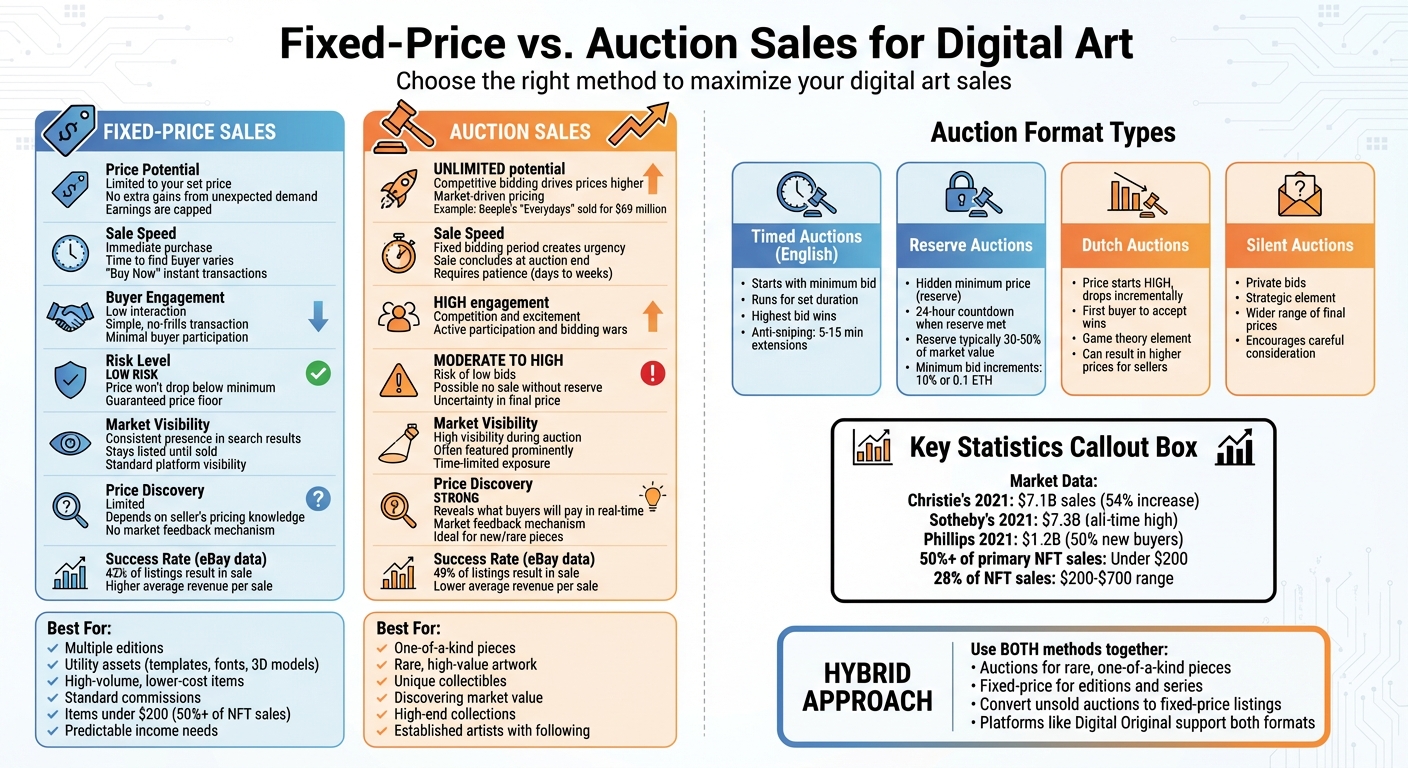
Fixed-Price vs Auction Sales for Digital Art: Complete Comparison Guide
How Fixed-Price Sales Work for Digital Art
Fixed-price sales are one of the simplest ways to sell digital art. You set a specific price - say, $250 in USDC - and buyers can purchase your artwork instantly, skipping the need for bidding. This method ensures quick and straightforward transactions. As Nansen puts it:
The seller outlines a price, and buyers have the option to buy the NFT without taking part in any bidding. The item sells at the price which the seller sets if it sells at all.
The Fixed-Price Sales Process
The process starts with approving the token, which authorizes the smart contract to handle your NFT. After that, you select the artwork, set your price (commonly in ETH, USDC, or other accepted tokens), and decide how long the listing will stay active - this can range from as short as 15 minutes to as long as six months. Once you sign the transaction, your listing goes live.
When a buyer hits "Purchase", they pay the fixed price along with any applicable gas fees. The smart contract then verifies the payment, transfers the NFT to the buyer’s wallet, and sends the funds directly to you. This transaction is permanently recorded on the blockchain, serving as an unchangeable proof of ownership - a digital certificate of authenticity. Platforms like Digital Original make the process even smoother by providing instant USDC payouts, with the smart contract handling all the details automatically.
From token approval to receiving payments, the entire process is automated, making it efficient and hassle-free.
Advantages of Fixed-Price Sales
The biggest perk? Immediate payment. Unlike auctions, where you might wait days for the bidding process to finish, fixed-price sales are completed as soon as a buyer is ready to purchase. You also have full control over pricing, letting you calculate your profit margins ahead of time. For example, if you spent 10 hours creating a piece at $50/hour and had $100 in software expenses, you can price your work to cover costs and ensure profitability.
Another benefit is reduced risk. With fixed pricing, you’ll never sell for less than your minimum acceptable amount. This approach works well for both limited and open editions. For artists looking to establish consistent income streams, fixed-price sales offer a “set it and forget it” method, with automation handling the entire process. It also eliminates the stress of watching auction bids fall short of your expectations.
This streamlined approach is a great option to consider before exploring other methods like auctions.
How Auction Sales Work for Digital Art
Auctions are a dynamic way to determine the value of digital art through competitive bidding. Unlike fixed-price sales, which offer immediate transactions at a set price, auctions rely on market forces to establish value. Sellers set a starting bid, and collectors compete to claim the piece, often driving prices higher - especially for rare or highly desirable works. As Nansen puts it:
Auctions provide greater efficiency compared to fixed price markets as auctions match products to buyers with the highest valuation in the market.
Let’s break down the most common auction formats used to engage buyers and maximize sales.
Common Auction Formats in Digital Art
Timed Auctions (English Auctions):
Timed auctions start with a minimum bid and run for a set duration. When the clock runs out, the highest bid wins. To prevent last-second bidding wars, many platforms use anti-sniping features that extend the auction by 5–15 minutes if bids come in near the end.
Reserve Auctions:
These auctions are similar to timed auctions but include a hidden minimum price, known as the reserve. If a bid meets or surpasses this threshold, platforms often trigger a 24-hour countdown to heighten competition and draw attention to the artwork.
Dutch Auctions:
In this format, the price starts high and drops incrementally until a buyer steps in. While buyers might wait for a lower price, they risk losing the piece to someone willing to act faster.
Silent Auctions:
Here, bids are kept private, adding an element of strategy. This secrecy can lead to a wider range of final prices and encourages bidders to think carefully about how much they’re willing to pay.
Reserve Prices and Bidding Strategies
Setting a reserve price is a balancing act. Sellers aim to avoid undervaluing their work while still encouraging bids. Many set reserves at 30% to 50% of the estimated market value, leaving room for competition while safeguarding their interests.
Platforms often require each new bid to exceed the previous one by at least 10% or a set minimum increment, such as 0.1 ETH. Some bidders use unconventional amounts - like $1,003 instead of $1,000 - to subtly discourage rivals.
Dutch auctions, in particular, introduce a layer of unpredictability. As Nansen explains:
The Dutch auction involves more game theory than other auction methods. This uncertainty often results in better prices for sellers as buyers sometimes pay a higher price, uncertain of what others are willing to pay.
For artists experimenting with pricing, no-reserve auctions are a bold choice. While riskier, they often draw larger crowds and create competitive momentum that can push final prices higher. Interestingly, over half of primary NFT art sales are priced under $200, highlighting the need for artists to understand their audience and position in the market.
Fixed-Price vs. Auction Sales: Comparing the Two Methods
Picking the right sales method depends on aligning your approach with your specific objectives. Each method offers a unique buyer experience and leads to different outcomes for sellers.
Fixed-price sales are all about predictability and ease. You set a price, and buyers can purchase immediately - no waiting, no guessing. This method is ideal if you want to plan profits ahead of time or are selling multiple editions of the same item. However, there's a catch: your earnings are capped, even if demand skyrockets.
Auction sales, on the other hand, thrive on competition and uncertainty. They can lead to much higher prices than you'd get with a fixed-price sale, but there's a trade-off. Without a reserve price, you risk selling for less than you'd hoped. Plus, auctions require patience, as buyers have to wait for the bidding period to close.
Take eBay as an example: 49% of auction listings result in a sale compared to 42% for fixed-price listings. Despite this higher success rate, fixed-price items bring in more revenue on average. Zack Rutherford from SaleHoo explains:
The auctioned items, however, sell for much less money. Therefore, the 42 percent of total sales on fixed price items ends up accounting for a much larger piece of the overall pie.
This breakdown highlights when each method might be the better fit for your digital art sales strategy.
Comparison Table: Fixed-Price vs. Auction Sales
| Factor | Fixed-Price Sales | Auction Sales |
|---|---|---|
| Price Potential | Limited to your set price; no extra gains from unexpected demand | Unlimited; competitive bidding can push prices much higher |
| Sale Speed | Immediate purchase; time to find a buyer varies | Fixed bidding period creates urgency; sale concludes at auction end |
| Buyer Engagement | Low; simple, no-frills transaction | High; competition and excitement drive active participation |
| Risk Level | Low; price won't drop below your set minimum | Moderate to high; risk of low bids or no sale without a reserve |
| Market Visibility | Consistent presence in search results until sold | High visibility during the auction period; often featured prominently |
| Price Discovery | Limited; depends on your pricing knowledge | Strong; reveals what buyers are willing to pay in real time |
When to Use Fixed-Price Sales for Digital Art
Fixed-price sales are a great choice when you need a predictable and quick way to sell your digital art.
This pricing method works particularly well for items like multiple editions and utility assets - think graphic packs, templates, logos, fonts, or 3D print models. These types of products are often seen as practical tools rather than one-of-a-kind collectibles, making fixed pricing a natural fit.
Fixed prices are also ideal for high-volume, lower-cost items such as Twitch emotes, social filters, avatars, or wallpapers. Similarly, they suit standard commissions like book covers or branding kits, where buyers benefit from the simplicity of clicking a "Buy Now" button and securing their purchase immediately.
For unique, one-of-a-kind artworks, auctions are usually better for discovering the best price. However, if no bids come in after a few weeks, adding a "Buy Now" option can help move the piece. To put this in perspective, during a 10-day stretch following the 2021 NFT boom, over 50% of primary sales on OpenSea were under $200, and about 28% fell between $200 and $700. These numbers highlight how fixed pricing works well for more accessible price ranges.
Best Situations for Fixed-Price Sales
Here are some scenarios where fixed pricing offers both buyer convenience and seller control.
Fixed pricing is perfect when you need immediate payment and buyers prefer knowing the exact cost upfront. Many collectors appreciate this clarity because it allows them to plan their purchases without worrying about being outbid or seeing prices climb beyond their budget. Jeffrey Lee, co-founder of frensHouse, captures this shift in buyer behavior:
Today, if young collectors have a choice, many of them don't want to deal with talking to a person. It can be a lot easier to just buy online.
Another advantage of fixed pricing is that it gives you complete control over your pricing strategy. Instead of charging for the time spent on a project, you can set prices that reflect the full value of your expertise. To maintain consistency and trust, make sure your prices are the same across all platforms, whether you're selling through your own storefront or a gallery. For high-volume listings, fixed pricing is a time-saver since the process becomes automated once your items are live.
sbb-itb-4e84554
When to Use Auction Sales for Digital Art
Unlike fixed-price sales, where the price is set in advance, auctions let the market decide the value of a digital art piece. This approach works particularly well for one-of-a-kind digital art, as competitive bidding often pushes prices higher than fixed-price methods. Fixed sales limit earnings to a predetermined amount, but auctions open the door to market-driven pricing. This is especially advantageous for high-end collections or well-known artists, where reputation can fuel bidding wars and drive up final sale prices.
Auctions also play a key role in determining the right price for new or rare digital art. As Doug Woodham, Managing Partner at Art Fiduciary Advisors, explains:
For new collectors, bidding at auction can be more reassuring than buying privately from a dealer as they get real-time feedback of market interest in a work. This gives people more confidence to spend.
The numbers back this up. In 2021, Christie's recorded $7.1 billion in sales - a 54% jump from 2020 - while Sotheby's hit an all-time high of $7.3 billion. Phillips also saw impressive growth, with global sales reaching $1.2 billion, and half of its buyers being new to the platform. One standout example is Beeple's digital masterpiece, Everydays: The First 5000 Days, which sold for an astonishing $69 million at Christie's. This sale showcases the immense potential auctions hold for unique digital art.
Best Situations for Auction Sales
Auctions are ideal when you want to gauge market interest without locking in a fixed price. Setting a realistic reserve price can encourage early bids, which is especially helpful if you're still building your audience. Many platforms activate a 24-hour countdown once the reserve is met, creating a final burst of intense bidding activity. Dutch auctions are another option, as they can reveal buyers' true willingness to pay.
Timing and promotion are just as important as pricing strategies. Short auction durations can create urgency, prompting quicker decisions, while longer durations give more collectors a chance to participate. To maximize engagement, promote your auction on platforms like Discord and Twitter to build excitement and drive competition.
Using Both Fixed-Price and Auction Sales Together
Benefits of Using Both Sales Methods
Combining auctions with fixed-price sales allows you to cater to a broader range of collectors. Some buyers thrive on the excitement of bidding wars, while others appreciate the ease of clicking "Buy Now" for an instant purchase.
Auctions are ideal for showcasing rare, high-value pieces, giving you the chance to achieve maximum sale prices. Meanwhile, fixed-price listings are perfect for buyers who prefer straightforward transactions. If an auction doesn’t meet your reserve price, you can easily pivot by relisting the item at a fixed price to attract those who may have missed out on the bidding.
Digital art sales span a wide spectrum, from affordable entry-level pieces to high-value investments. This diversity highlights the importance of offering flexible options to appeal to both casual buyers and serious collectors ready to make significant purchases. Platforms like Digital Original simplify this dual approach, making it easier to manage your sales strategy.
How Digital Original Supports Both Sales Methods
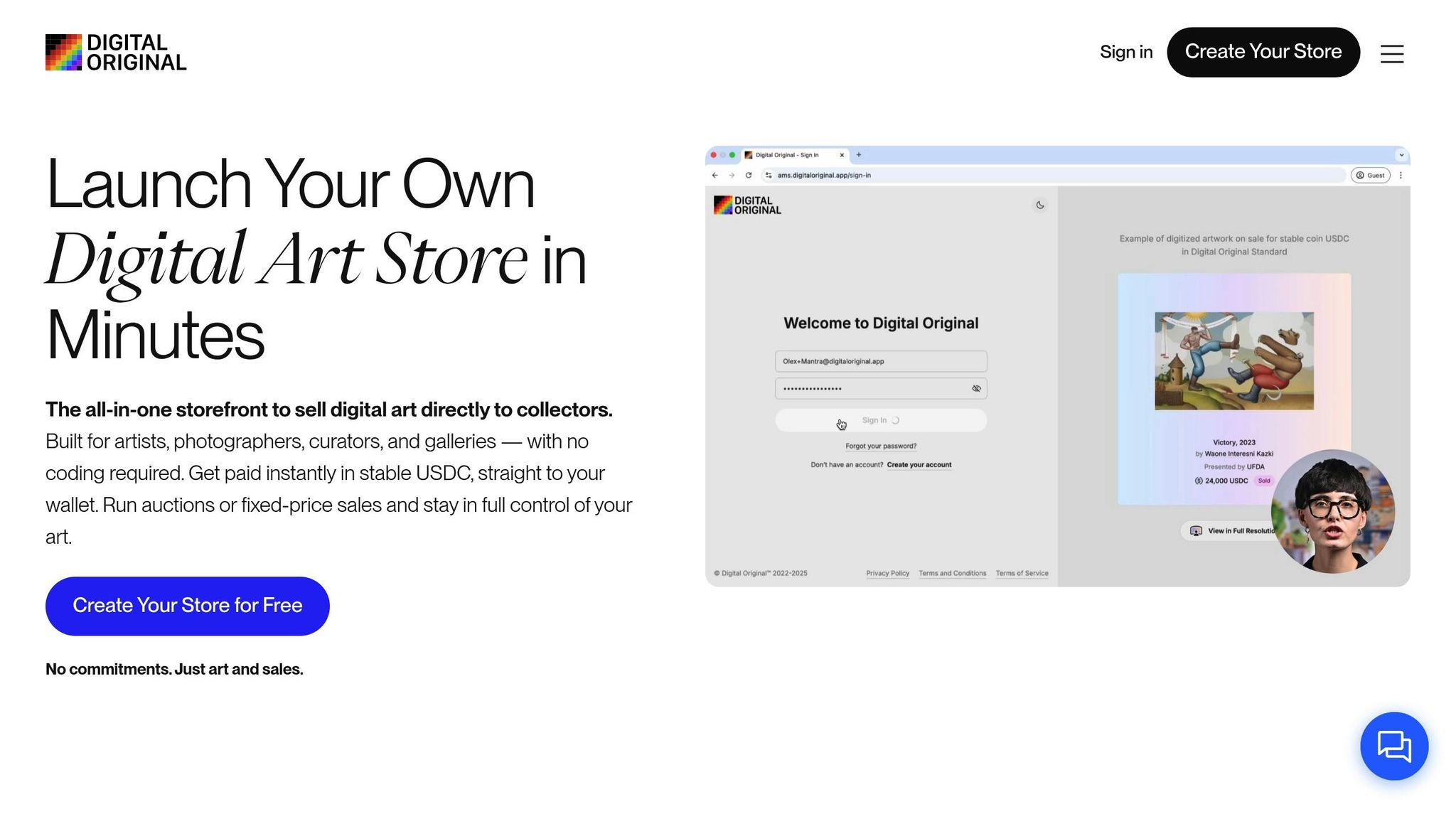
Digital Original streamlines the process of managing both auctions and fixed-price sales in a single platform. Your storefront can seamlessly display both formats side by side, with no coding skills required. The platform’s smart contracts - audited with a 9.8/10 rating by Blaize - automate everything from auction settlements to direct sales, saving you the hassle of handling transactions manually.
For example, in 2025, renowned muralist Waone Interesni Kazki auctioned his artwork "Victory" for 24,000 USDC through Digital Original. At the same time, multidisciplinary artist Louis-Paul Caron used the platform to sell three "phygital" originals via fixed-price listings. Both artists retained 95% of their revenue and received instant USDC payouts, showcasing how the platform supports different sales approaches with transparent terms and immediate payments.
Conclusion: Choosing the Right Sales Method for Your Digital Art
Deciding between fixed-price sales and auctions isn’t about finding a single “best” method - it’s about aligning your approach with your artwork, audience, and goals. Fixed-price sales are ideal when you need simplicity and clear profit margins, especially for high-volume listings of similar pieces. On the other hand, auctions shine when it comes to uncovering the market value of unique, high-end art, connecting you with buyers willing to pay a premium.
Your audience also plays a huge role in shaping this decision. If you’ve built a loyal following, auctions can create excitement and encourage competitive bidding. For newer artists, fixed pricing offers a safer route, providing certainty and avoiding the risk of an auction that fails to attract bids. Data shows that aligning your pricing method with the value and uniqueness of your work is key to maximizing success.
"Pricing strategy should always be situation-specific, allowing you to select the best approach for your creative and financial operation." – Hanging Investments
A hybrid approach can combine the best of both worlds. Reserve auctions for your rare, one-of-a-kind creations where discovering the right price is essential. Use fixed pricing for editions, series, or pieces aimed at collectors who prefer straightforward purchases. Platforms like Digital Original make this strategy easy by supporting both formats within a single storefront.
To get started, take a close look at your collection. Identify which pieces are truly one-of-a-kind versus those that belong to a series or edition. Match each type of artwork to the sales method that aligns with your financial goals and the preferences of your audience. By experimenting with both approaches, you can fine-tune your strategy and achieve the best results.
FAQs
What are the benefits of using both fixed-price and auction sales for digital art?
Using both fixed-price sales and auctions gives artists the best of both worlds. Fixed-price listings offer buyers clear pricing and an easy, no-hassle way to purchase - perfect for collectors who want to secure a piece right away. Auctions, on the other hand, bring energy and competition into the mix, often driving up sale prices when demand is high.
This combination helps artists reach a wider audience - those who prefer the certainty of fixed prices and those who thrive on the thrill of bidding. It also adds flexibility and boosts visibility. Fixed-price options keep steady interest flowing, while auctions can spark excitement and push prices higher for sought-after pieces. Platforms like Digital Original make managing both formats a breeze with tools like smart contracts, instant USDC payouts, and verified digital ownership, allowing creators to maximize their sales effortlessly.
What is a reserve price, and how does it impact digital art auctions?
When it comes to auctions, the reserve price is the lowest amount a seller is willing to accept for their digital artwork. If no bids reach this threshold, the piece simply won’t be sold.
This pricing strategy helps ensure the seller receives a fair value for their work while also sparking competitive bidding. But here’s the catch: setting the reserve price too high can backfire. It might scare off potential buyers, lower participation, and leave the artwork unsold. Finding that sweet spot is crucial for a successful auction.
When should an artist switch from fixed-price to auction sales for digital art?
When a fixed-price sale isn’t sparking enough interest or offers for their artwork, an artist might consider switching to an auction. Auctions often generate excitement and urgency, especially for one-of-a-kind pieces or limited editions, as collectors compete to set the final price. This competitive atmosphere can sometimes lead to higher sales, particularly if there’s strong demand or buzz surrounding the artwork.
Switching to an auction can also make sense when there’s growing attention from collectors, media coverage, or a goal to establish a higher baseline value through bidding. Auctions are a great way to tap into market enthusiasm and uncover the actual value of a piece when fixed pricing isn’t hitting the mark.
With Digital Original, artists can smoothly transition from fixed-price listings to auctions using smart contract-backed tools. The platform offers instant USDC payouts and verified digital ownership, making it easy to adapt to the ever-changing market landscape.


