USDC for Art Payments: Why Stablecoins Are Becoming the New Standard


USDC for Art Payments: Why Stablecoins Are Becoming the New Standard
USDC, a stablecoin pegged 1:1 to the US dollar, is changing how art transactions happen. It offers fast payments, fewer fees, and global access, making it a preferred choice for artists and collectors. Unlike volatile cryptocurrencies, USDC ensures price stability, allowing artists to receive exact amounts and buyers to pay confidently. With blockchain technology, transactions are secure, transparent, and free from chargebacks. For artists, this means keeping more of their earnings, while collectors benefit from quick, straightforward payments. Solutions like Digital Original are already using USDC to streamline global art sales and automate royalties through smart contracts. This stablecoin is not just a payment method; it’s a tool simplifying and improving the art market experience.
Key benefits of USDC for art transactions:
- Fast Settlements: Payments complete in minutes, even on weekends.
- Lower Fees: Avoid high credit card or wire transfer costs.
- Global Access: Artists and collectors can transact worldwide without banking barriers.
- Transparency: Blockchain records every transaction, reducing fraud risks.
- Smart Contracts: Automate royalties and revenue splits for ongoing earnings.
USDC is reshaping the art world by addressing common payment challenges and offering a reliable, efficient alternative.
Introduction: The Problem with Traditional Art Payments
Slow Settlements and High Fees
Traditional payment methods like bank wires can take anywhere from 3 to 5 business days to settle, leaving funds inaccessible during that time. Imagine a gallery selling a $200,000 piece of contemporary art on a Monday but not seeing the money in their account until Friday. This delay can disrupt essential business operations.
Credit card payments bring their own headaches. One major issue is chargeback risk - where a buyer can reverse a transaction weeks after it’s completed. For artists and galleries, this could mean losing both the artwork and the payment. This is especially tough on independent artists, who often rely on limited cash reserves to keep their operations running.
And then there are the fees. Credit card transactions typically cost 2–3%, while international wires can eat up as much as 5–10% of the total sale. On a $100,000 art transaction, that’s a loss of $5,000–$10,000 just in fees.
Challenges with Global and Digital Markets
While digital art is inherently borderless, traditional payment systems are anything but. Cross-border payments often involve multiple intermediaries, unfavorable exchange rates, and even outright exclusion of certain regions from participation. This makes it harder for artists and buyers to connect in a truly global market.
There’s also a frustrating mismatch in timing. Digital art can be transferred instantly, but traditional payment systems lag behind. For example, while an on-chain digital art transfer happens in seconds, a wire transfer might take days to complete. This delay can cause trust issues and complicate cash flow for artists and galleries.
These hurdles highlight the need for a payment solution that’s fast, cost-effective, and universally accessible.
USDC as the Solution
USDC (USD Coin) offers a way to sidestep these challenges by enabling payments that settle in just minutes - or even seconds - any time of day, including weekends and holidays. By cutting out intermediaries, USDC transactions come with much lower fees and settle directly on public blockchains.
For artists selling to a global audience, USDC eliminates the pain points of slow settlements, high fees, and geographic barriers. All that’s needed is internet access and a crypto wallet to send or receive payments instantly, no matter the location or banking infrastructure. Plus, blockchain technology ensures transparent and traceable records, reducing fraud risks and simplifying compliance.
Interestingly, Stripe notes that buyers using stablecoins are twice as likely to be first-time customers. This suggests that faster, more affordable payment options can attract new buyers who might have been discouraged by traditional payment hurdles.
What Is USDC and Why the Art Market Is Adopting It
USDC in Simple Terms
USDC (USD Coin) is a type of digital currency that’s pegged 1:1 to the U.S. dollar. Unlike cryptocurrencies that can swing wildly in value, USDC stays steady. It’s issued by Circle, a regulated financial services company, and backed by reserves held in cash and short-term U.S. Treasuries.
Think of USDC as a digital version of the dollar, built on blockchain technology. It offers the reliability of traditional money combined with the speed and transparency of blockchain. Essentially, holding 100 USDC is the same as holding $100 in cash.
What sets USDC apart from other cryptocurrencies is its lack of speculation. Its value is directly tied to real-world assets, making it a stable and predictable choice for financial transactions. This stability is a game-changer for the art world.
Why Stability Matters in Art Transactions
In the art market, price certainty is non-negotiable. When a gallery lists a digital artwork for $5,000, both the artist and the buyer expect that amount to remain unchanged. Cryptocurrencies with fluctuating values can disrupt this expectation, leading to financial headaches for everyone involved.
USDC eliminates that problem. For instance, if a collector pays 24,000 USDC for a piece, the artist is guaranteed to receive exactly $24,000. This kind of predictability simplifies transactions and removes the need for last-minute adjustments.
For galleries and curators who operate across international markets, USDC’s stability is particularly useful. Pricing artworks in USD and accepting USDC payments shields them from exchange rate swings. It’s also a lifeline for independent artists, providing the financial reliability they need to plan and grow their practices without worrying about sudden value changes.
Mainstream Adoption of Stablecoins
USDC’s predictable value has attracted significant institutional support. Major payment networks have embraced it, adding to its credibility. For example, Mastercard allows users to spend stablecoins at over 150 million merchant locations worldwide through partnerships with platforms like MetaMask, Crypto.com, OKX, and Kraken.
Visa has also tapped into stablecoins, recognizing their potential to speed up and reduce the cost of cross-border transactions, especially in emerging markets. Meanwhile, e-commerce platforms like Shopify and WooCommerce have made it easier for merchants to accept USDC payments via crypto plugins, giving artists a seamless way to integrate USDC into their online stores.
This institutional backing highlights USDC’s reliability as a modern payment option. Plus, the blockchain’s transparency ensures that all USDC transactions are recorded on public ledgers, making them tamper-resistant, traceable, and easy to audit. For galleries managing inventories or artists handling taxes, this built-in record-keeping is a huge time-saver, cutting down on administrative work while ensuring compliance.
Stablecoins, USDC, and the Future of Digital Money
The Key Benefits of Using USDC for Art Payments
USDC offers more than just predictable value - it brings speed, cost efficiency, and security to art transactions.
Faster Payments with Finality
With USDC, transactions are completed in seconds or minutes, unlike traditional payment methods that can take days to process. When a collector buys a piece of art, the artist receives payment almost immediately, avoiding the delays that often come with credit card or wire transfers. This quick turnaround boosts cash flow, allowing artists to reinvest their earnings right away. Plus, USDC transactions are final and irreversible, eliminating the risk of chargebacks.
Lower Transaction Costs
Processing payments through credit cards typically incurs fees of 2.9–3.5%, plus additional fixed charges per transaction. Add in currency conversion or cross-border fees, and costs can climb even higher. International wire transfers often come with steep flat fees and unfavorable exchange rates. By using USDC, these intermediaries are bypassed, and network fees are usually just a few cents. This means artists and galleries keep more of their earnings.
Borderless Payments and Global Reach
USDC’s design makes global transactions simple, eliminating the need for traditional banking systems. This is particularly valuable for artists in regions with unstable currencies. It also opens doors to international collectors, enabling a gallery in one country to sell effortlessly to a buyer in another without worrying about currency conversion issues, declined international cards, or slow bank transfers. Interestingly, data shows that customers paying with stablecoins are twice as likely to be first-time buyers compared to those using traditional methods.
Transparency and Fraud Prevention
Every USDC transaction is recorded on a public blockchain ledger, which is tamper-resistant and transparent. This creates a clear audit trail, confirming when payments were made and to which address, reducing disputes over payment issues. By connecting payment records with blockchain-based proof of ownership or provenance, the risks of fraud, double-selling, or fake receipts are significantly reduced. These features also pave the way for secure, automated transactions through smart contracts.
Programmable Payments via Smart Contracts
USDC supports smart contracts, which automate payment processes with precision. For instance, when a digital artwork is sold, a smart contract can instantly divide the proceeds - sending 70% to the artist, 20% to the gallery, and 10% to a curator - all in one transaction without manual intervention. These contracts can also enforce royalties on secondary sales, ensuring a set percentage goes back to the original artist with each resale. For custom commissions, milestone payments can be programmed, releasing funds only when specific goals are met. This builds trust in cross-border collaborations and reduces administrative errors. Solutions like Digital Original use these features to ensure accurate revenue distribution among artists, galleries, and curators.
sbb-itb-4e84554
Why Stablecoins Are Outperforming Traditional Payment Methods
When artists and galleries weigh their payment options, USDC consistently outshines credit cards and bank transfers in three key areas: speed, cost, and reliability.
Comparison of Payment Methods
The differences between USDC and traditional payment systems become clear when you look at how they perform in real-world transactions.
| Feature | USDC / Stablecoins | Credit Cards | Bank Transfers / Wires |
|---|---|---|---|
| Settlement Speed | Seconds to minutes; available 24/7/365 | Instant authorization; settlement takes 1–3 days | Domestic: hours to 1 day; international: 1–5+ business days |
| Transaction Fees | Network fees only (usually cents); no intermediaries | Around 2–3% plus fixed fees per transaction | $15–$50+ flat fees, plus FX spreads and intermediary charges |
| Global Reach | Works anywhere with internet and a crypto wallet | Dependent on card networks and local infrastructure | Limited by correspondent banks and local capital controls |
| Chargeback Risk | Transactions are final and irreversible | High risk due to disputes and chargebacks | Limited recall options and less traceability |
| Operating Hours | 24/7/365 with no holidays | Authorization is 24/7; settlement limited to banking hours | Business days/hours only; subject to cut-off times |
| Programmability | Enables smart contracts for royalties, splits, and escrow | No programmability at settlement level | Minimal programmability; often requires external software |
This table highlights USDC's superiority in speed, lower costs, and global accessibility compared to traditional payment methods.
Unlike traditional banking systems, which shut down on weekends and holidays, USDC operates continuously. This is especially advantageous for international transactions. Credit cards charge merchants about 2–3% plus fixed fees, while international wires often cost $15–$50 or more and come with unfavorable exchange rates. USDC eliminates these intermediaries entirely.
According to Worldpay, USDC settlement allows merchants to avoid wire costs and FX fees while still transacting in familiar currencies.
On-Chain Payments for Collectors
Now, let’s look at how collectors benefit directly from using USDC for on-chain payments.
To use USDC, collectors need a crypto wallet such as MetaMask, Phantom, or Coinbase Wallet. Setting up a wallet is quick and requires minimal effort, unlike traditional banking systems that often involve extensive paperwork and long processing times.
Once their wallet is funded, collectors can connect it to art platforms or custom storefronts to authorize USDC payments. As soon as the transaction is confirmed, ownership of the NFT or tokenized certificate is transferred instantly. Both the payment and ownership change are recorded on the public blockchain for full transparency.
This system creates a seamless environment where collectors can verify ownership through their wallets and benefit from features like built-in resale rights powered by smart contracts. For buyers in regions with limited banking access, all that’s needed is a smartphone and an internet connection to participate in global art markets. This opens up opportunities for collectors who might otherwise be excluded by conventional payment systems.
Regulation and Stability of USDC
Unlike cryptocurrencies prone to wild price swings, USDC maintains a stable 1:1 peg to the US dollar. Each USDC token is backed by reserves - cash and short-term US Treasuries - held by Circle, a US-regulated entity. This ensures the speed and global reach of blockchain payments without the volatility.
USDC also complies with KYC/AML regulations, making it a trusted option for institutions like galleries, auction houses, and museums. Major payment networks like Visa, Mastercard, and Worldpay have already integrated USDC into their operations, including treasury, settlement, and payout systems.
By early 2025, Deutsche Bank projected the stablecoin market cap to exceed $245 billion, reflecting the growing trust in stablecoins as a legitimate payment tool rather than a speculative asset.
In regions with high inflation, stablecoins often trade at a premium. This shows that people value quick access to dollar-linked assets and more reliable payment systems. For art collectors in emerging markets or unstable economies, USDC provides a way to preserve value and participate in global art markets without the risks tied to local currency fluctuations.
Platforms like Shopify, WooCommerce, and Stripe now support stablecoin payments, making it easier than ever for artists and galleries to accept USDC. These platforms offer fewer barriers and better financial terms compared to traditional methods, giving creators and collectors alike a more efficient way to transact.
With its regulatory backing and stable design, USDC is becoming an integral part of digital art transactions, offering a streamlined and secure payment experience for all parties involved.
USDC for Digital Art, NFTs, and Tokenized Revenue Streams
USDC is transforming the digital art world by enabling seamless sales, NFT transactions, and automated payouts for creators. Its near-instant settlement and programmable features are reshaping how artists and collectors interact.
USDC in NFT Marketplaces
NFT platforms increasingly rely on USDC as a stable currency to price and settle digital art transactions. By using USDC, buyers and sellers can see clear, dollar-equivalent values, eliminating the guesswork often associated with fluctuating cryptocurrencies.
On blockchain networks like Polygon or Solana, transaction fees are incredibly low - often less than $0.01. For example, if a digital artwork sells for $5,000, artists retain almost all of their earnings, avoiding the steep cuts typically taken by intermediaries. This fee structure ensures creators get their fair share while keeping costs minimal.
Transparency is another major advantage. Blockchain technology records every USDC payment for NFTs on-chain, creating a permanent history of ownership and sale prices. This immutable record helps collectors verify authenticity and provides a clear provenance for every piece of digital art.
This combination of low fees and transparency also lays the groundwork for automated royalty payments.
Automating Royalties with Smart Contracts
Smart contracts simplify royalty management by automating payments on secondary sales. When an artist mints an NFT, the smart contract can be programmed to allocate a fixed percentage of every future resale directly to the artist’s wallet in USDC.
For instance, if an artist specifies a 10% royalty and a collector resells the NFT for 5,000 USDC, the contract instantly transfers 500 USDC to the artist, while the rest goes to the seller. This process happens automatically, 24/7, without requiring any manual intervention. Smart contracts can even handle more complex revenue-sharing agreements, dividing payments among collaborators based on pre-set percentages.
This automation provides artists with ongoing income streams. Unlike traditional art sales, which typically yield one-time payments, NFTs with USDC-powered royalty contracts generate revenue every time the artwork is resold. The transparency of smart contracts ensures that both artists and collectors can confirm royalties are distributed as intended.
With these capabilities, platforms are now leveraging USDC to streamline the entire digital art ecosystem.
Role of USDC on Digital Original
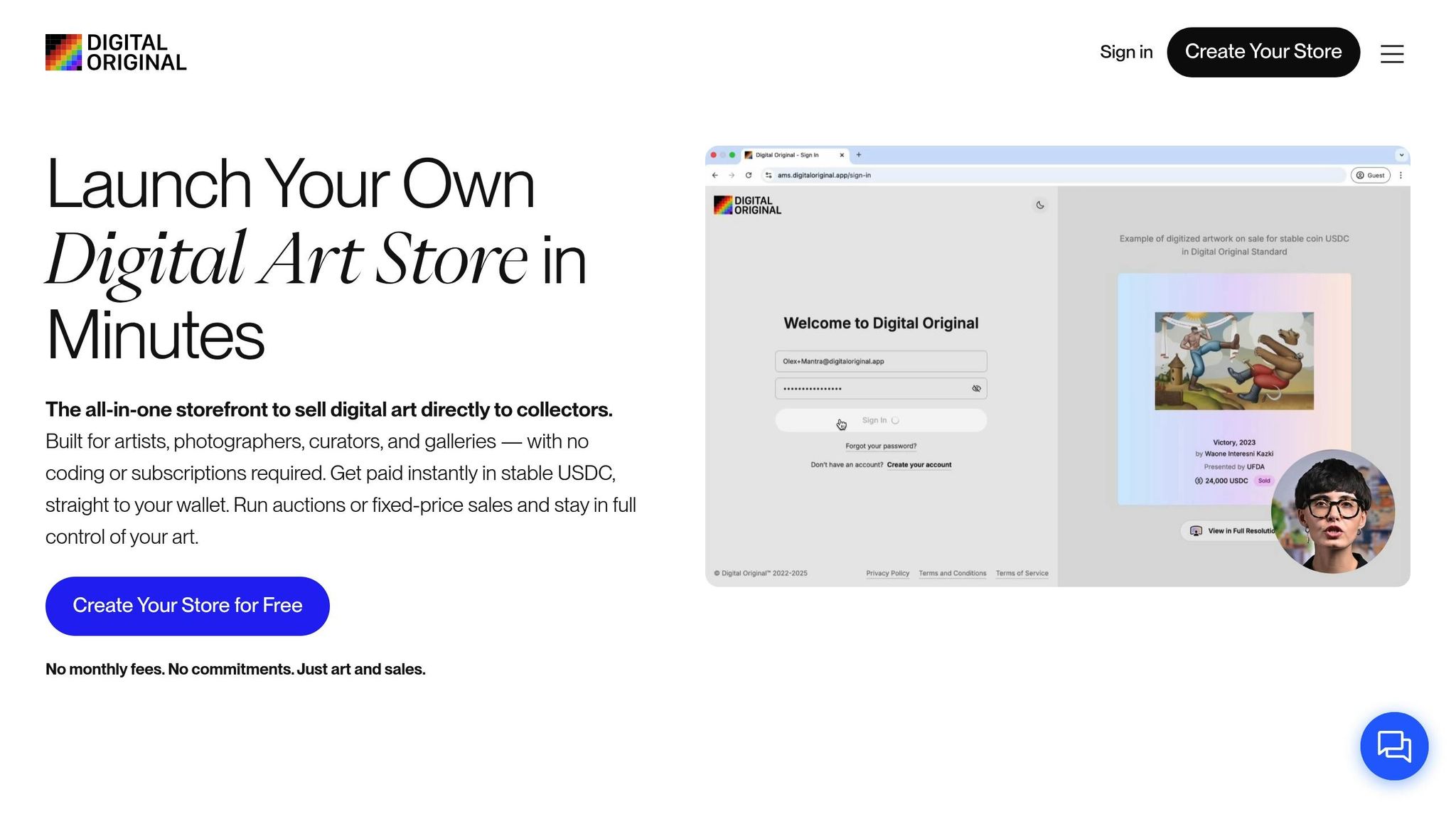
Digital Original exemplifies how USDC can enhance digital art commerce at every stage. When a collector buys artwork through the storefront, the USDC payment is instantly transferred to the artist’s wallet, enabling immediate access to funds.
Digital Original integrates USDC to offer instant payouts, automated royalties, and clear revenue splits among artists, galleries, and curators.
What Most People Get Wrong About USDC Art Payments
Clearing up misconceptions about USDC is essential for artists and collectors to fully enjoy its speed and reliability. Misunderstandings about volatility, compliance, and wallet security can lead to unnecessary risks in art transactions. Let’s break these down.
Misunderstanding Crypto Volatility
A common mistake is assuming USDC behaves like Bitcoin or Ethereum, with their notorious price swings. But USDC is a stablecoin, pegged to the U.S. dollar, meaning its value stays consistent at $1. So, if you sell a piece of digital art for 5,000 USDC, you’re receiving $5,000 - not a speculative asset that could drop to $4,000 the next day.
Circle, the company behind USDC, regularly publishes reports showing the reserves backing every token. This transparency ensures stability, even in turbulent markets. For artists and collectors, this is crucial - your agreed price remains the price paid, without worrying about sudden value changes.
In short, USDC combines the speed of blockchain payments with the dependability of a digital dollar, free from the volatility of other cryptocurrencies.
Compliance and Tax Responsibilities
Another misconception is that USDC payments somehow bypass traditional tax and regulatory rules. In reality, receiving USDC for art sales is treated just like receiving regular U.S. dollars.
For instance, selling an NFT for 2,000 USDC means reporting $2,000 as taxable income. If you later exchange that USDC for fiat or another asset, any value change could trigger capital gains or losses - though with a stablecoin like USDC, these changes are typically minimal.
To stay compliant, artists and galleries should maintain detailed transaction records, including dates, amounts, USD value at the time of receipt, and buyer information. Tools like Koinly or CoinTracker can simplify this process by importing transaction histories and generating tax reports. This is especially useful for those managing multiple sales.
When using regulated platforms or payment processors to accept USDC, these services often handle buyer identity verification. For example, if a collector purchases art using USDC through a platform with Know Your Customer (KYC) requirements, the platform ensures the funds are legitimate before transferring payment. While this reduces the need for artists to vet each buyer, it’s still wise to use reputable and regulated services to avoid receiving funds from questionable sources.
One thing to remember: while blockchain payments are transparent and traceable, they’re not anonymous. Firms like Chainalysis can track USDC transactions, so it’s unrealistic to treat stablecoin payments as hidden from authorities.
Securing Wallets and Private Keys
Once compliance is addressed, wallet security becomes the next critical step. Many artists and galleries underestimate the importance of securing their wallets, which can lead to irrecoverable losses.
With self-custody wallets like MetaMask or Ledger, access to your funds depends entirely on your private key or seed phrase. If you lose these, your USDC is gone for good. Similarly, unauthorized access can drain your wallet, with no way to reverse the loss. This makes proper key management absolutely essential.
Here’s how to protect yourself:
- Use a dedicated wallet for art sales.
- Keep larger balances in hardware wallets (cold storage) and only small amounts in hot wallets for daily use.
- Store your seed phrase offline in multiple secure locations - never save it digitally or share it with anyone.
Phishing scams are another major threat. Scammers often create fake wallet apps or send fraudulent emails to trick users into revealing their seed phrases. Always double-check URLs, enable two-factor authentication, and verify wallet addresses before making transactions. A single mistake can result in permanent loss.
USDC payments are final and irreversible at the protocol level. If you accidentally send funds to the wrong address, there’s no way to reverse the transaction. While this protects sellers from chargebacks, it also means you need to double-check every transaction carefully.
For artists and galleries managing high sales volumes, using custodial wallet services or solutions like Digital Original can simplify operations. These services integrate USDC payments with added security features, reducing the risks and complexities of managing private keys while still offering the benefits of stablecoin payments.
Key Takeaways: Why USDC Is the Future of Art Payments
USDC is making waves in the art world by combining stability, speed, and programmable features into a payment method that works seamlessly for creators, galleries, and collectors. This digital currency is already revolutionizing how art is bought and sold, especially in the digital space.
USDC as a Stable and Efficient Payment Method
USDC stands out because it’s backed 1:1 by USD reserves, ensuring that 5,000 USDC is always worth $5,000. Circle, the issuer, provides regular reports to maintain transparency about these reserves. Transactions with USDC are fast, final, and cost significantly less than traditional payment methods like credit cards or bank wires. This is a big win for both high-value artworks and smaller digital pieces, as it helps protect margins.
Interestingly, data from Stripe reveals that buyers using stablecoins, like USDC, are twice as likely to be first-time customers. This suggests USDC is opening doors to new buyers who might not have used conventional payment methods. Another major advantage is the elimination of chargeback fraud. Since USDC transactions are irreversible and transparent, they provide a level of security that traditional card payments simply can’t match.
Enabling Global Art Markets
USDC is also transforming the global art scene by removing the barriers of borders and outdated banking systems. Operating on public blockchains, USDC allows for seamless international transactions, avoiding the delays and fees tied to local banks or SWIFT transfers. In places with high inflation or limited banking options, USDC serves as a reliable way to store value and make payments. According to Chainalysis, stablecoins are so sought after in these regions that they often trade at a premium because users value their stability and speed.
Imagine a collector in a country with strict banking controls. With just a smartphone and a crypto wallet, they can send the equivalent of USD without worrying about foreign exchange fees or banking restrictions. This kind of accessibility is a game-changer for digital artists, allowing them to sell their work globally without needing foreign bank accounts or dealing with complicated wire transfers.
As USDC breaks down these barriers, its integration with smart contracts takes art transactions to the next level.
The Role of Smart Contracts in Art Commerce
Smart contracts make USDC much more than just a payment method - they turn it into a tool for automating essential processes like royalties, revenue splits, and escrow payments.
For example, when a piece of art is resold, smart contracts can automatically ensure the artist receives their royalties in USDC at the time of transfer. Solutions like Digital Original benefit greatly from this, as artists can set royalty terms once and trust that every future sale will honor those terms without needing their direct involvement.
FAQs
How does USDC provide secure and transparent transactions for art purchases?
USDC leverages blockchain technology to offer a high level of security and transparency. Every transaction is documented on a public ledger, ensuring it can be traced and remains tamper-resistant. On top of that, smart contracts streamline the payment process by automating transactions. These contracts minimize errors and disputes by releasing funds only when pre-set conditions are fulfilled. This transparency fosters trust between artists and collectors, making USDC a strong option for art-related transactions.
Why is USDC a better option for international art transactions than traditional payment methods?
USDC brings several perks to international art transactions, making it a strong alternative to traditional payment methods. As a stablecoin pegged to the US dollar, it ensures consistent value, eliminating concerns about currency exchange rate shifts or market instability. This is especially useful for high-value art deals where price certainty is essential.
Beyond stability, USDC transactions are quicker and more affordable. Traditional bank transfers can take days to process and often come with steep fees for cross-border payments. In contrast, USDC allows for almost instant transfers at a fraction of the cost. This speed and efficiency are a game-changer for the fast-paced global art market, where reliable transactions are key.
Another standout feature is its use of blockchain technology, which ensures security and transparency. Both artists and collectors can verify transactions directly on the blockchain, reducing fraud risks and fostering trust throughout the payment process.
How does USDC use smart contracts to simplify royalties and revenue sharing for artists?
Smart contracts simplify the process of handling royalties and revenue sharing by automating every step. When an artwork is sold, the smart contract instantly and precisely divides the earnings, sending the agreed portions in USDC directly to the designated wallets.
This approach removes delays, minimizes mistakes, and gives artists immediate access to their earnings, ensuring a clear and streamlined payment process.


