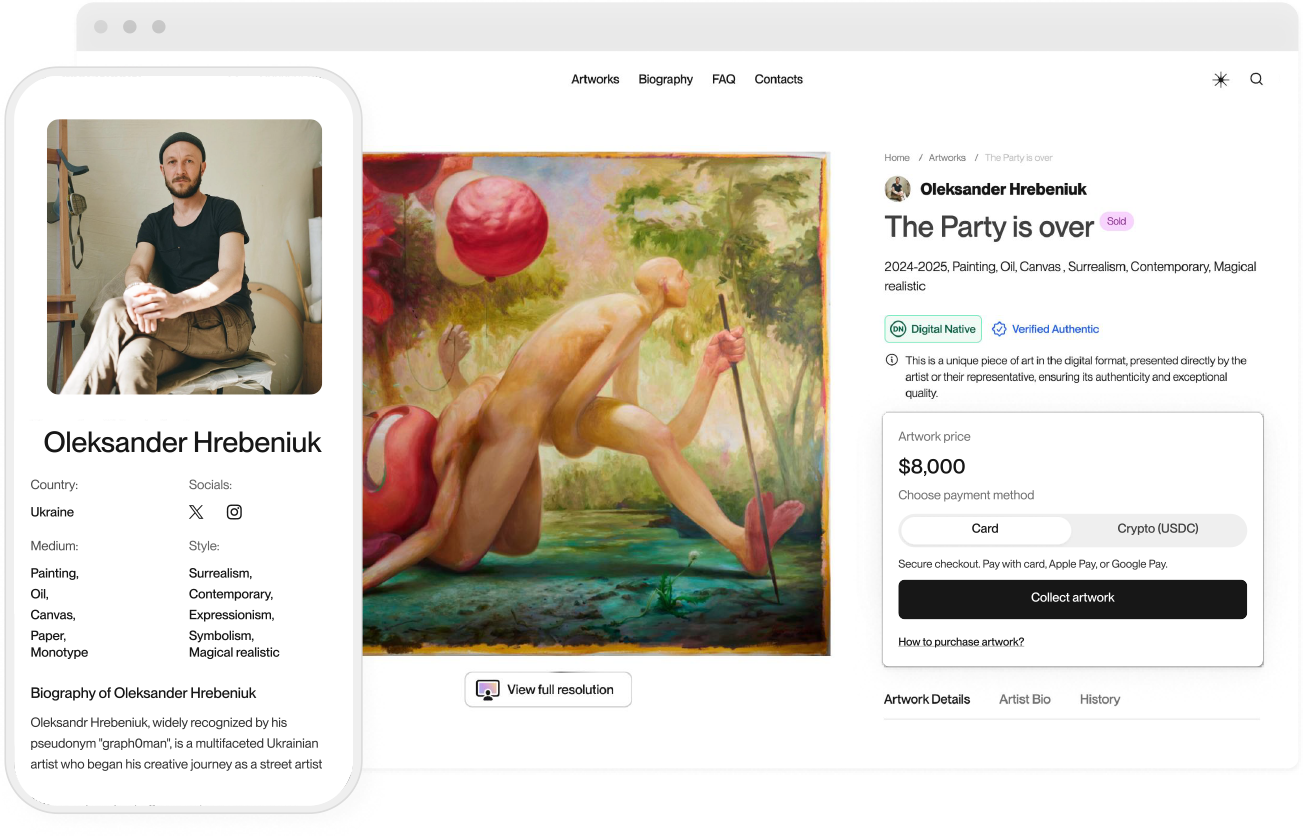

TL;DR: No code portfolio websites for artists are now the default way to present digital work professionally — no developer and no design degree required. They let any artist build a self-owned space with full-quality image display, a custom domain, and series-based presentation in under an hour. In 2026, the best artist portfolio websites pair zero technical friction with art-specific features that social media cannot offer.
The Shift to No-Code: Why Technical Barriers are Vanishing for Artists
Direct Answer: No code portfolio websites for artists remove the need for HTML, CSS, or hosting setup. The artist builds a professional showcase through a visual, block-based editor — choosing layouts and uploading work directly. This shift means presentation quality, not technical skill, now decides how an artist's work is perceived online.
For two decades, a credible art website meant hiring a developer or learning to code. That barrier left many serious artists dependent on social feeds they did not control. No-code platforms changed the economics. A block-based editor handles layout, responsiveness, and hosting, so the artist focuses only on the work and its sequence.
The result is measurable. Setup time for a first portfolio dropped from days to under an hour on most modern platforms. Maintenance — adding a series, updating a statement — now takes minutes. This is confirmed by a wider tooling trend: industry reports indicate that 57% of professional creators cite fragmented, hard-to-manage tools as a top obstacle. No-code consolidates that fragmentation into one editable space.
"Technical ability should never decide whose art gets seen. A no-code portfolio gives the artist back the one thing social platforms removed — control over how the work is presented."
— Yehor Shustyk, Product at Digital Original
Best Art Portfolio Websites in 2026: Comparative Analysis
Direct Answer: The best art portfolio websites in 2026 differ mainly in how well they serve art-specific needs — file fidelity, series structure, and honest plan limits. Digital Original, Behance, Adobe Portfolio, Wix, and Squarespace each fit a different artist profile. The table below maps each platform to its strongest use case.
The comparison reflects platform features as of Q2 2026.
|
Platform |
Best For |
No-Code Level |
Key Feature |
Free Tier |
|
Digital Original |
Digital artists who want art-specific presentation |
Full — block-based editor |
Deep Zoom full-resolution display |
No — 7-day trial, then paid plans |
|
Behance |
Maximum exposure inside a creative network |
Full — profile-based |
Built-in discovery audience |
Yes — unlimited projects |
|
Adobe Portfolio |
Photographers and designers in the Adobe ecosystem |
Full — template-based |
Lightroom and Creative Cloud sync |
Included with Creative Cloud |
|
Wix |
All-purpose websites with broad customization |
Full — drag-and-drop |
Large template and app library |
Yes — with Wix branding |
|
Squarespace |
Polished general-purpose business sites |
Full — template-based |
Strong design templates |
No — trial only |
Each platform is competent at what it targets. The distinction for a digital artist is art-specific depth: whether a platform shows a high-resolution file without compression, supports series, and states its plan limits clearly. General builders like Wix and Squarespace excel at flexibility; art-first platforms prioritize fidelity and presentation.

Free Artist Portfolio Websites: Top Picks for 2026
Direct Answer: The strongest free artist portfolio websites in 2026 are Behance and Adobe Portfolio. Behance leads on built-in exposure and Adobe Portfolio on workflow integration for photographers. Digital Original is the paid art-first alternative, built for presentation control. The right pick depends on whether an artist prioritizes discovery, presentation, or ecosystem fit.
Behance – The Industry Standard for Exposure
Behance is a free portfolio network owned by Adobe with a large built-in audience. An artist publishes unlimited projects and gains visibility inside an established creative community. The trade-off: the work lives on a shared domain, inside a feed and ranking system the artist does not control. Presentation follows Behance's fixed layout, not the artist's intent.
Digital Original – Professionalism and Presentation Control
Digital Original gives the artist a self-owned space rather than a profile on a shared network. Its plans include unlimited artworks, Deep Zoom full-resolution display, and a custom subdomain — a custom domain can be connected on Plus and Pro. Deep Zoom matters for digital work: viewers explore the texture and detail of a piece instead of a compressed thumbnail. Layout, sequence, and context stay under the artist's control.
Adobe Portfolio – Best for Photographers and Designers
Adobe Portfolio is included with any Creative Cloud subscription and syncs directly with Lightroom. For photographers and designers already paying for Adobe tools, it is an efficient, no-extra-cost option. It is less suited to artists outside the Adobe ecosystem, since it is not available as a standalone free product.
|
Platform |
Works limit |
Own space and domain |
Art-specific display |
|
Behance |
Unlimited |
Shared network domain |
Standard image grid |
|
Digital Original |
Unlimited |
Custom subdomain plus custom domain |
Deep Zoom, full resolution |
|
Adobe Portfolio |
Limited by plan |
Custom domain |
Standard, Lightroom-synced |
This distinction matters because discovery is shifting. Industry data indicates that around 51% of art buyers regularly find work through Instagram — yet feeds compress files and bury series. Digital Original platform data (2026) shows that work presented with Deep Zoom holds viewer attention roughly 2.4 times longer than a standard image grid. A dedicated portfolio captures that interest in a space the artist owns.
How to Choose the Best Portfolio Sites for Artists
Direct Answer: Choose among the best portfolio sites for artists by matching the platform to your primary goal — exposure, presentation control, or workflow fit. Evaluate file fidelity, free-tier limits, domain ownership, and series support before design templates. For digital artists, art-specific display usually matters more than template variety.
Use this checklist to compare any platform against what a serious art practice actually needs:
-
File fidelity — Does the platform show a high-resolution file without compression? Compression erases the detail that defines digital work.
-
Free tier — Is there a genuine free plan, or only a trial? A real free tier lets an artist test presentation before paying.
-
Domain and ownership — Can you connect a custom domain to your own space, instead of using a shared profile URL?
-
Series and structure — Can works be grouped into series or selections, not just a flat grid?
-
Maintenance effort — How long does it take to add a new work or update a statement?
-
Growth path — Does the platform scale into analytics, audience tools, and sales when you are ready?
Rank these factors by your stage. An emerging artist may weight exposure and free-tier limits highest. An established artist preparing to sell will weight ownership, fidelity, and a clear growth path.
Expert Insight: Protecting Your Digital Art
Direct Answer: Protecting digital art online means protecting three things — its visual quality, its authorship context, and the artist's control over where the work lives. A self-owned portfolio safeguards all three: work displays at full resolution, the statement frames authorship, and the space cannot be reshaped by a platform's algorithm.
On social media, an artwork is exposed to compression, recontextualization, and feed ranking. The image loses detail, the series loses sequence, and the work sits beside unrelated content. A portfolio website restores the conditions a gallery provides — full quality, intentional order, and context.
A custom domain adds another layer. The artist's address belongs to them, not to a network that may change its rules. Pairing each work with a clear title, year, and statement strengthens authorship further — it records intent and originality in the artist's own words.

"When artworks lived only on Instagram, every post competed with memes and ads. Moving it to my agency website changed how people treated it — they slowed down and looked. The work finally read as art, not as content."
— Anna Avetova, Curator and Digital Original user
Build your digital art space.
Digital Original gives serious artists one space to present, grow, and monetize their work.
Unlimited portfolio, Deep Zoom on every image, video, 3D, your own subdomain or custom domain. Create your website →