Selling Art Online: What Collectors Need to See Before They Buy


In short
Discovery can happen on Instagram, in a studio, at an exhibition or through search. The decision to inquire or buy requires more information than a single image can provide.
Collectors need to see the complete work, essential details, credible authorship, availability and a clear next step. A professional artwork page brings those elements together.
More collectors are buying directly from artists
Recent collector research points to a growing direct relationship between artists and buyers. That relationship rarely belongs to a single platform.
The Art Basel and UBS Survey of Global Collecting 2025 found that 63 percent of the surveyed high-net-worth collectors had purchased directly from an artist in 2024 or 2025. Within that group of channels, 43 percent bought from artists' studios, 37 percent commissioned work and 35 percent used Instagram to find and purchase directly from, or through a link to, an artist.
Artist direct sales represented 20 percent of spending by value in the survey. The findings describe 3,100 high-net-worth collectors and should not be treated as a measure of every art buyer. They still show an important behaviour: collectors move between channels and expect a direct way to continue once a work attracts their interest.
Discovery creates interest; trust supports a sale
An image may begin the relationship. Clear, credible information helps it continue.
A collector may first encounter an artwork in a feed, a shared message, a search result or a physical exhibition. How you promote your art decides which of those comes first. The next questions are practical. Who made it? Is it part of a series? What is the medium and scale? Is it available? How can the artist be contacted?
If these answers are scattered across posts and profiles, interest can end before an inquiry begins. Give each important artwork a stable page on your own website that can answer the first round of questions without requiring a direct message.
Let people see the whole work and its details
Let people see the work as a whole, then move closer when detail matters.
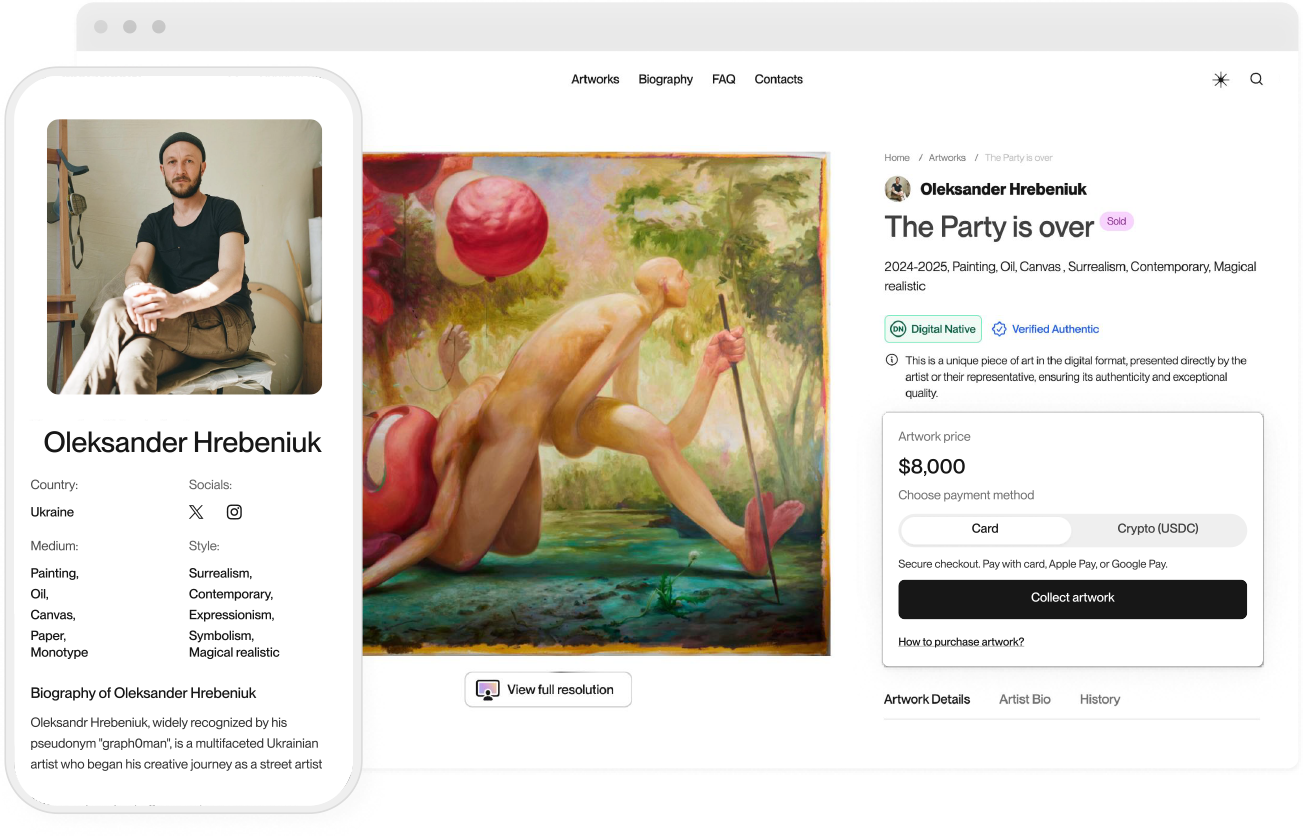
The main image should show the work without decorative interference. Add close views when surface, texture or fine digital detail matters. For sculpture, installation and dimensional work, include several angles. A photograph in a room or beside a familiar object can make scale easier to understand.
Do not rely on feed crops as the final presentation. They are useful for attracting attention, but they can remove edges, alter composition and hide the details that make the work distinctive.

Make the essential facts easy to find
The essential facts should be accurate, consistent and easy to find.
-
Title and year
-
Medium and materials
-
Dimensions and units
-
Edition information when relevant
-
Availability or current status
-
Location and delivery limitations when relevant
-
Price or a clear way to request it
Use the same wording and units across your website, certificates, invoices and exhibition documents. Consistency reduces confusion and makes the work easier to reference later.
Give the work enough context
A few precise sentences are more useful than a long statement that could describe any work.
Describe what the work explores, how it was made and where it belongs in your practice. Two to five focused sentences are often enough. Avoid explaining what every viewer should feel. Give the reader information that cannot be recovered from the image alone.
Link to the wider series and to your biography. A collector evaluating one work often wants to understand continuity across the practice.
Make authorship and availability clear
Make the artist, the status of the work and what accompanies a purchase easy to understand.
Use your full professional name consistently. Explain whether the work is an original, an edition or a digital file. State whether a certificate of authenticity, signed documentation or another record is included. Mention representation or exhibition history only when it applies to the specific work and can be verified.
Make the next step obvious
Someone interested in the work should not have to search for the next step.
Use a clear action such as Request to Purchase, Ask About Availability or Commission a Related Work. Tell the visitor what happens after the request. If the purchase is completed manually, say that you will confirm availability, shipping and payment details.
Direct sales still depend on conversation and trust.

The website does not replace that relationship. It makes the beginning of the relationship clearer.
Yehor Shustyk
Product Manager @ Digital Original
Bring every channel back to one professional place
One well-made artwork page can support discovery, conversation, search and direct inquiry.
Digital Original gives each artwork room for a full-quality view, context, sales information and Deep Zoom. The same page can be shared after a studio visit, linked from Instagram or found through search — one stable place for the relationship to continue.
For artists selling art online, this gives every discovery channel one credible place to lead.
Sources and image credits
Research: The Art Basel and UBS Survey of Global Collecting 2025.
Cover: Untamed 05, Between Us 04 and Between Us 03 (2026) by Simon Portbury. Editorial composite created for Digital Original.
Inline images: Untamed 01 (2026) by Simon Portbury. Editorial composites created for Digital Original.