
TL;DR: Search in 2026 means Google and AI agents like ChatGPT and Perplexity. Both need one stable, structured address to find and cite an artist's work — not a set of scattered social profiles. A custom domain, paired with real metadata on every piece, is what makes a portfolio discoverable and citable, not just visible.
What "Being Found" Means for Artists Now
Direct Answer: Being found no longer means ranking on a results page alone. AI agents answer questions directly and cite sources they can crawl and trust. An artist gets cited only if their work sits at a stable, structured address.
For most of the last decade, discoverability meant SEO — keywords, backlinks, a listing on Google. That's no longer the whole picture. People increasingly ask an AI agent directly: "find me a landscape photographer with a strong aerial series." The agent answers from what it can crawl and verify. Google, ChatGPT, Perplexity, and Gemini share the same requirement underneath: content with a stable address and enough structure to cite with confidence. According to Adobe's Creators' Toolkit Report (Oct 2025, N=16,000), 85% of creators say they'd use an AI agent that learns their style and represents them — but that only works if the agent can find structured information about the artist first.
Why a Scattered Presence Costs You Visibility
Direct Answer: Instagram, Behance, and page-builder trials are each useful, but no social media profile is built to be an artist's single indexed source. Split across five platforms, work becomes invisible to search engines in the same way it's invisible to a unified brand.
Most artists build an online presence the same way: an Instagram grid, a Behance page, maybe a website trial. Each carries a piece of identity, but none is the definitive one. Search engines and AI crawlers favor a single, well-structured source they can trust and re-crawl. A fragmented presence also has a real cost — a subscription for a page builder, plus the time spent keeping five profiles current. Per Digital Original's market research, drawing on Market.us and Mordor Intelligence industry data (2025), 57% of professional creators name fragmented tools their top operational challenge. That fragmentation is exactly what a single owned domain resolves.

Your Domain Is a Compounding Asset, Not a One-Time Setup
Direct Answer: A domain gains authority every time something else online links to it — a bio, a feature, a mention. That authority builds over years and keeps working long after the link was posted.
Link building is the process of getting other pages to point back to yours. Every social bio, every feature, every "see more at [name].com" adds a small signal of trust. Search engines and AI systems treat frequently-cited domains as more credible, and cite them more often in return. This accumulated trust is what SEO tools measure as domain authority. This isn't a task an artist finishes once — it compounds as long as they stay active online. A five-year-old domain with a hundred honest mentions outweighs a brand-new one with none, even when the newer artist's work is just as strong. Collector behavior backs this up: per Market.us and Mordor Intelligence (2025), 51% of collectors say they regularly discover new work through Instagram — but that discovery only turns into lasting visibility if it links back to one owned address.
Not every mention carries equal weight. A reference from an established art publication, gallery, or foundation signals far more than a link in a social bio. Search engines and AI systems weigh the authority of the source, not just the count.
Why a Custom Domain Solves Name Ambiguity
Direct Answer: If other people share your name, search engines and AI agents have no reliable way to know which works are yours. A custom domain acts as the anchor that ties scattered mentions to one verified body of work.
Name ambiguity is a problem most artists don't anticipate. Two illustrators with the same name split each other's search results. AI agents, asked to find one of them, return a blend of both — or neither. A domain built from your artist name gives every mention a fixed destination to point at, and makes your artist website that destination. Over time, that single address becomes the entity that search engines and AI systems associate with your work, rather than a name that resolves to several different people.
What a Structured Portfolio Gives You That a Feed Can't
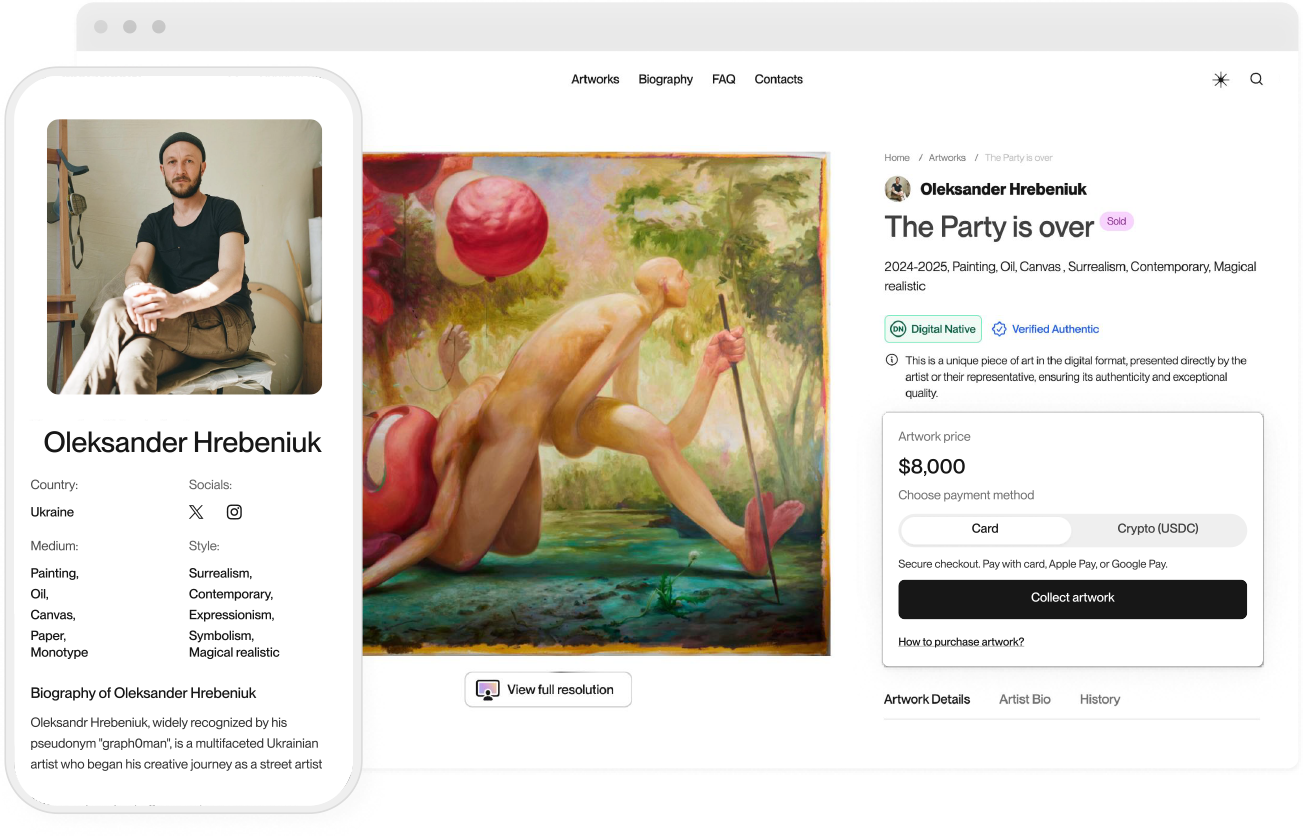
Direct Answer: A dedicated art portfolio website on your own domain can carry full-resolution files and structured metadata — medium, year, series, edition — for every work. Social feeds compress images and store almost none of this.
|
Platform |
Custom domain |
Metadata per work |
File quality |
Free tier |
|---|---|---|---|---|
|
Instagram / social feed |
No |
Title and caption only |
Compressed on upload |
Free |
|
Behance |
No |
Title and tags |
Compressed preview |
Free |
|
Squarespace |
Yes |
No art-specific fields |
Original, on paid plans |
From $16/mo |
|
Digital Original |
Yes, on Plus and Pro |
Medium, year, series, edition, and more |
Original quality with Deep Zoom |
No, 7-day trial |
The gap isn't cosmetic. Structured metadata is exactly what a search engine or an AI agent reads to classify and cite a work correctly — a caption alone can't do that job.
How to Set Up Your Own Art Domain in Under an Hour
Direct Answer: Register a domain built from your artist name, connect it to a portfolio that supports full metadata, and add structured details to every uploaded work. This is a one-time setup, not an ongoing project.
-
Pick a brand name and check availability — a domain typically costs $5–25 a year (.com, .art, or similar).
-
Register it with a mainstream registrar. (ex. https://www.namecheap.com)
-
Create your Digital Original website and connect the domain. Custom domain connection is available on the Plus and Pro plans — connect it once, and every mention starts pointing to one address.
-
Upload work in its original high-resolution format and fill in the metadata for each piece: medium, year, series, description.
-
Add the domain to every bio and profile still active elsewhere, so everything you do to promote your art points to one address.

What This Sets Up for Later
Direct Answer: Once a domain and structured metadata are in place, the same foundation supports selling digital and phygital editions when the artist is ready. That's a downstream step, not the starting point.
Visibility comes first because sales follow an audience of art collectors, not the other way around. Only then does it make sense to sell art online. A well-structured, discoverable portfolio is what makes any later step — storefront, licensing, a gallery inquiry — possible in the first place.
Expert Insight
"An artist's domain is the one asset that keeps working after the post disappears. Everything else is rented attention."
— Yehor Shustyk, Product Lead at Digital Original