How to Build an Online Presence as an Artist: A Practical Guide

An artist's online presence doesn't start with social media.
Presenting yourself systematically online is a skill of its own, and it isn't always obvious to digital artists and photographers. Marketing and the technical side aren't what an artist tends to focus on first, so an online presence often comes together on its own — plenty of activity, little visible result.
Below is an approach you may find clearer, more useful, and more predictable. It isn't a "secret to success" — it's a foundation you can build on.
Why the usual path rarely works
An artist's path online usually begins the same way: signing up across many platforms at once — Behance, Instagram, Adobe Portfolio — and trying to build an audience through content.
The difficulty is that almost every artist goes there too. The stream is enormous, and it's easy to stay unnoticed inside it. On top of that, visibility is governed by algorithms — hard to predict, and not always working in your favor.
Artists often look to more successful peers and try to repeat their moves. But following someone else's playbook rarely works in art: every artist has their own way of self-expression, and a borrowed script seldom fits.
None of this cancels social media — it's just not where you should start.
Step 1. Your press kit
Start with the materials about yourself, gathered into one set. You'll reuse it everywhere: on your own site, in open call applications, in emails to galleries, in messages to communities.
What goes into a press kit:
- Bio — a short version (2–3 sentences) and an extended one.
- Artist statement — who you are as an artist and what you do.
- Your portraits — a few photos of yourself: what the artist looks like, not only the work.
- Avatar.
- Logo, if you have one — a signature asset that's associated with you and shown alongside your work.
- Selected works — your strongest pieces. For a photographer, that's your best shots and series (Selections), not the whole archive.
- Contacts and links.
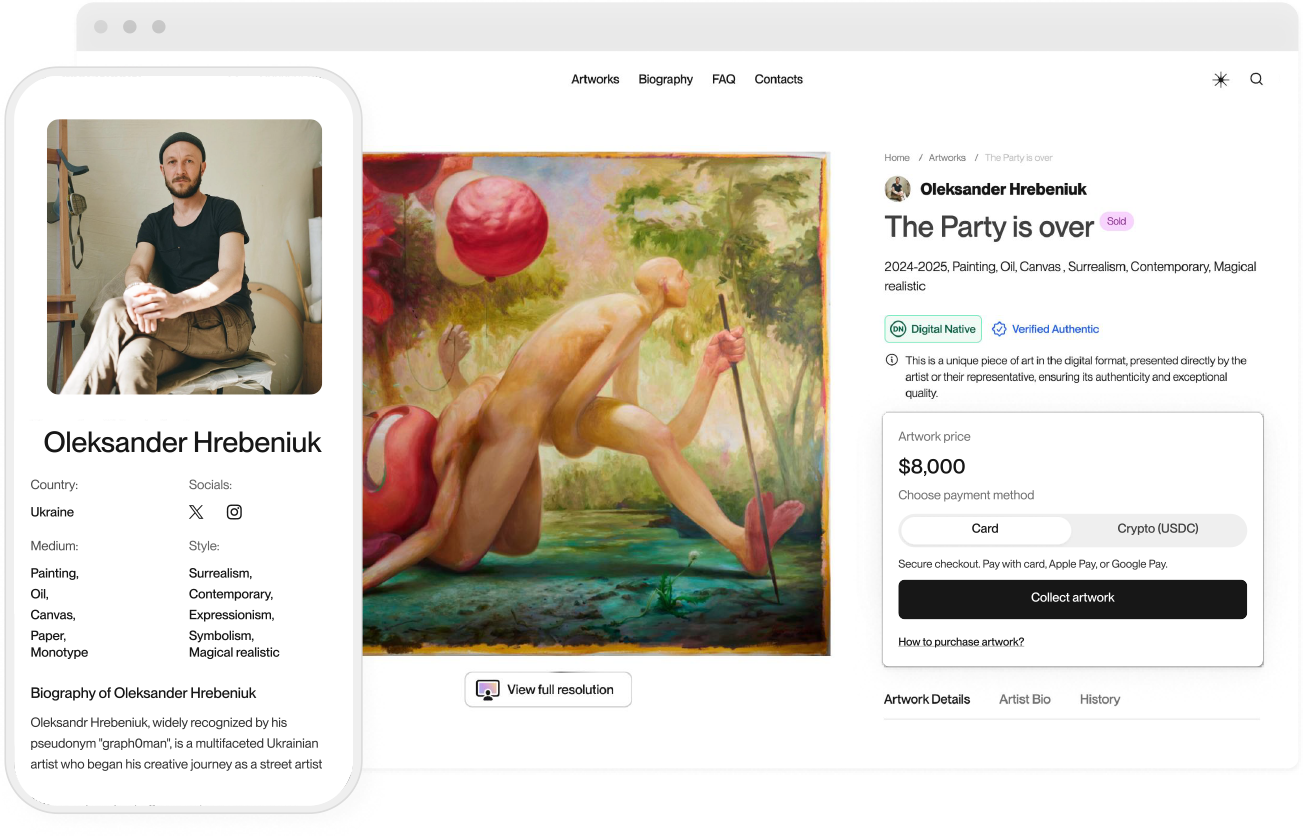
Put this together once and keep it in one place, so you don't rebuild it from scratch each time. Your Digital Original portfolio website becomes exactly this saved, structured version of your press-kit — always at hand and updated in a single spot.

Step 2. Defining your style and profile
Before others see you, it helps to clearly understand — and be able to describe — what you do and what your art is.
Three questions worth answering:
- What the work is — direction, medium, themes. For a photographer: macro, aerial, landscape, fine-art, narrative, abstract.
- How you see yourself as an artist.
- How you want others to see and perceive you.
This is your positioning — what sets you apart from the stream and makes you recognizable. Later, this wording becomes the basis of your bio, your captions, and how others talk about you.
Step 3. Your goals: what you want to achieve
It's worth writing down, for yourself, what you want as an artist and what matters to you. Goals differ from person to person:
- to be seen and noticed;
- to gain recognition among professionals;
- to stand alongside the artists you look up to;
- to grow an audience of your own;
- in time to start selling your work.
Your goal shapes everything that follows: which platforms to choose, what content to make, and who to approach for collaborations. Without one, it's easy to spread yourself across everything at once and get nowhere.
Step 4. Your website: the foundation of your presence
The next element is your own artist website. Setting one up today isn't hard, and it takes no technical skills: you add your content and information, and the site essentially builds itself in a few minutes.
The website becomes the foundation of your online presence. It's the place that holds information about you and your work, and where all the links from other platforms lead.
Why a website rather than one more profile:
- You're not competing with algorithms. There's one place where your art portfolio and artist profile live.
- A website indexes best in Google and other search engines, and with AI agents — when it's built for it.
Digital Original is built for exactly this. It uses structured markup: data about each work and about you is stored in the right format. And it's made first and foremost for viewing — work can be explored in high-resolution detail through Deep Zoom and XR. General website builders don't offer that: they're universal, but not tuned for art to be examined in full detail. Meanwhile the cost of hosting a portfolio is comparable, and the interface is simpler.

Why a custom domain is essential
For your site to index properly and work as your anchor online, you need to connect a custom domain. Without it, the site won't index or do its job — so it's not optional, it's a required step.
- A domain costs roughly $3–$20 a year.
- You can pick any zone — .art, for example.
- Keep it short, so it's easy to type.
Connect the domain, and the foundation is in place.
Step 5. Presence: social media, communities, and publications
Presence is everywhere you can be found and talked about: social profiles, topical communities and groups, publications, and mentions. This is where art marketing for an artist begins. Now you can return to this — but with intent.
- Profiles on social platforms relevant to your direction.
- Communities and groups where artists and photographers talk, share experience, and support each other: Reddit (for instance, r/photography, r/macrophotography, r/landscapephotography), topical Instagram communities, niche platforms.
- Activity turns into reach. When your work and profile draw attention, likes, and comments, algorithms pick you up more readily — and reach grows.
- Events around your brand: collaborations, co-authorships, open calls, awards, festivals, exhibitions, and letters to galleries. The more mentions, the better.
AI agents help a lot with the routine here — ChatGPT, Claude, Gemini, Grok. You can create a dedicated project, add context (who you are, your direction, your work), ask it to study your materials, and delegate finding platforms and preparing content. The decision always stays with you.
One key rule: anything you do online — an article, a post, a mention — should link back to your website.
And to turn that gathered attention into something real, point the links to your own site, where your work is seen in full quality. It's your point of assembly: all the traffic leads here, this is where people study your work, and from here — when you're ready — the first sales come.

Step 6. Link-building: domain authority for the long run
The more links point to your site, the higher its domain authority (domain rating). Link building is the slowest part of SEO, and the most durable. The more often and better you index and show up in search and with AI agents. When someone searches for an artist in your style, genre, with attributes like yours — they find you rather than the rest.
This doesn't happen in a day. Links grow over the long run — months, sometimes years. But if art is your calling, you're in it for the long haul anyway, so it's worth thinking about now.
Whoever starts earlier will be more visible in digital than the rest. And being noticed in the digital space is noticeably easier than seeking opportunities in the physical one.
In short: brand first, sales follow
To sum up: the first stage is building your brand as an artist in the digital environment.
A brand takes years and rests on your presence in the information space — the same principles as in the physical world. The more people write about you, the better. Once the brand is built, the audience grows. You keep up the routine — content, publications, collaborations, taking part in events — and the audience grows further. It's an ongoing process.
And it's only with a grown audience that the chance of sales appears: art collectors may want to donate, commission a piece, or buy a finished work. That is the point at which it makes sense to sell art online. Views come more easily; sales are harder, and they arrive as a consequence of the whole journey, not its starting point.
That's the essence of the approach. Digital Original is the place where you publish your original work in full quality and lay the foundation of your presence.