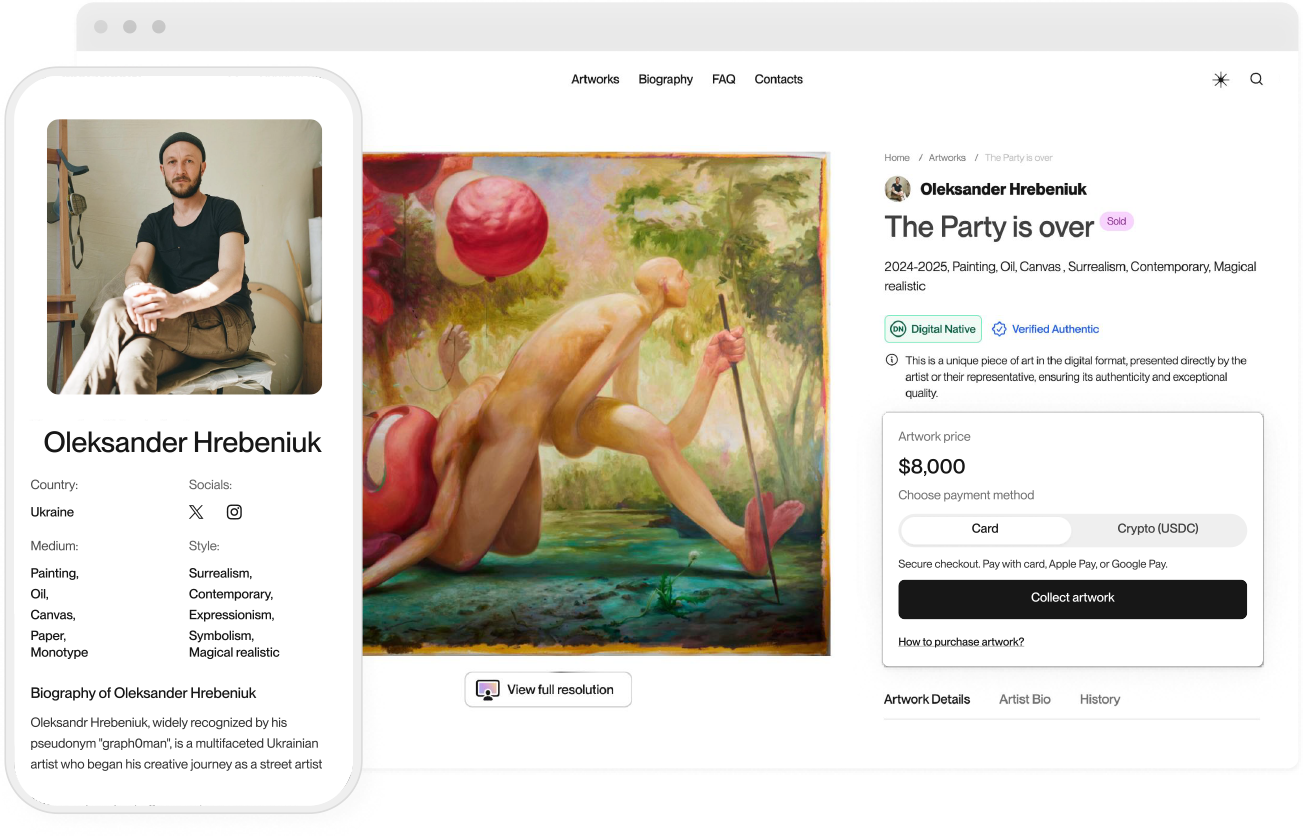
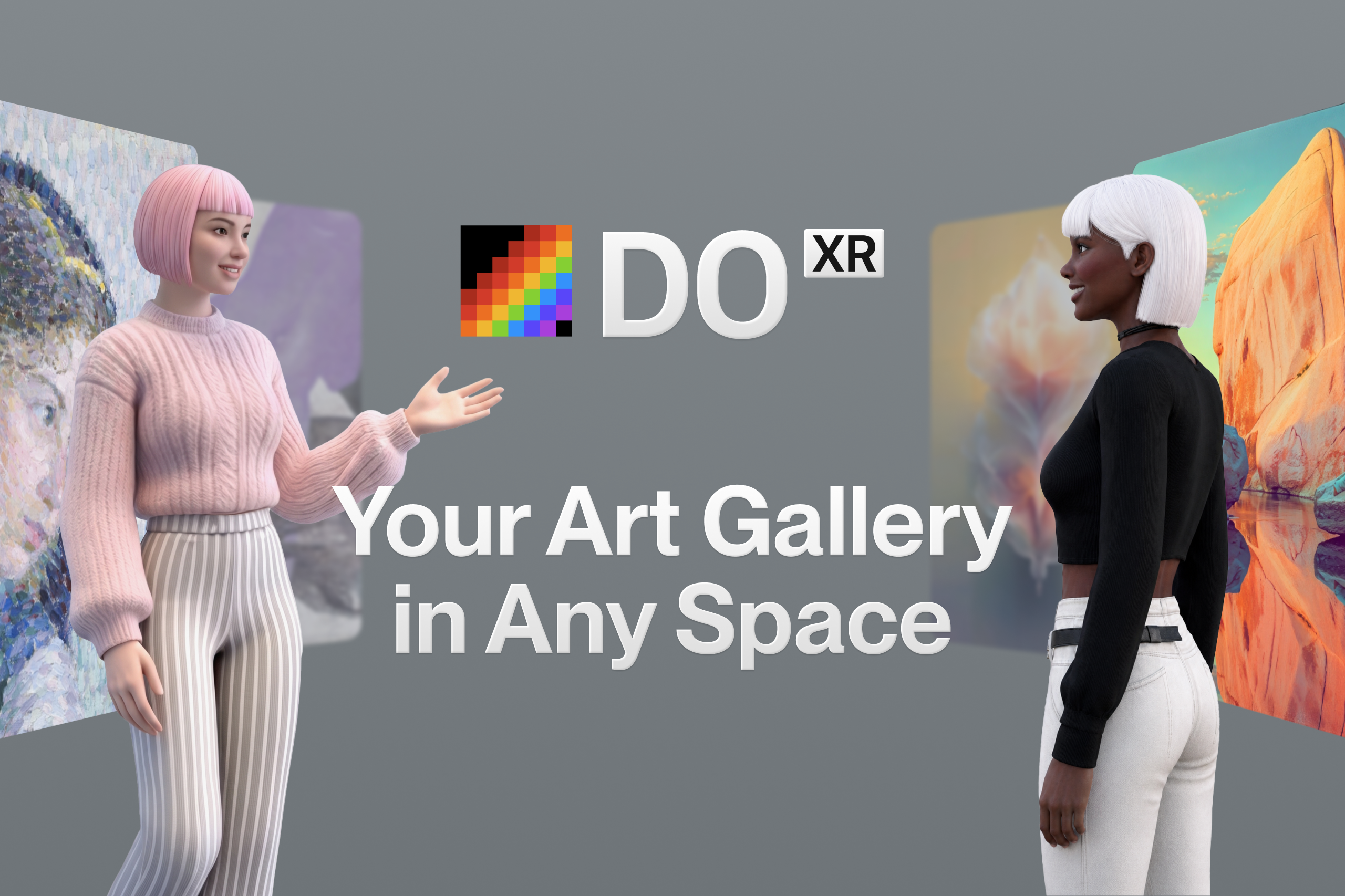
TL;DR: A virtual art gallery is an immersive space where digital artworks are displayed at full scale and explored in three dimensions, not on a flat screen. With an XR headset like Meta Quest, viewers can walk up to works, see fine detail, and experience art the way they would in a physical gallery. Artists can build their own virtual exhibitions, share them by link or code, and reach audiences anywhere in the world.

What is a virtual art gallery?
Direct Answer: A virtual art gallery is a digital exhibition space where artworks are presented in three dimensions and experienced through XR or VR. Unlike a website grid or social feed, it recreates the sense of scale, distance, and presence you feel standing in a real gallery.
The difference is spatial. On a screen, every artwork shrinks to the same rectangle. Detail flattens. Scale disappears. A two-meter painting and a postcard look nearly identical in a feed.
In a virtual art gallery, that changes. You move through the space. You approach a work. You step back to take it in whole. The physical logic of viewing art returns — proximity, distance, and presence all matter again.
This is why immersive presentation resonates with digital artists who feel their work loses something on flat screens. It adds a dimension to an artist online presence that a flat grid cannot. The medium finally matches the ambition of the work.
How does a virtual art gallery work?
Direct Answer: A virtual art gallery works through an XR headset that renders artworks as objects in 3D space. The viewer navigates the room, approaches works to reveal detail, and can view alone or with others in a shared space.
The core mechanic is progressive detail, the same technique as Deep Zoom. As a viewer moves closer to a work, higher-resolution layers load. The artwork becomes sharper the nearer you get — the same tiling logic that powers map applications, applied to art.
This solves a real technical constraint. Standalone headsets have limited memory. Loading full-resolution detail everywhere at once would break performance. Loading it only where the viewer looks keeps the experience smooth and high-fidelity.
The result is an immersive art experience where walking toward a painting rewards you with detail — texture, brushwork, nuance — that a thumbnail could never show.

Who is a virtual art gallery for?
Direct Answer: Virtual art galleries serve digital artists, independent galleries, curators, and collectors. Anyone who wants to present art with scale and context — beyond the limits of a flat screen — benefits from an immersive exhibition.
For digital artists, it offers a presentation that respects the work. Paintings, collage, illustration, and design from your art portfolio website are shown at the intended scale, in a space built for viewing rather than scrolling.
For galleries and curators, an online art gallery removes the wall-space constraint. A physical room fits only so many works. A virtual gallery has no such limit — full collections can be shown on-site through a headset or remotely to a distant audience.
For art collectors, it answers a practical question: how does this work actually feel at scale? Previewing a piece at true size before acquiring it changes the decision.
|
Audience |
Primary benefit |
Use case |
|---|---|---|
|
Digital artists |
Full-scale, high-fidelity presentation |
Personal exhibitions, series viewing |
|
Galleries & curators |
No wall-space limit |
Extended shows, remote exhibitions |
|
Collectors |
True-scale preview |
Evaluating works before acquiring |
|
General audience |
Access from anywhere |
Visiting exhibitions remotely |
How to build your own virtual art gallery
Direct Answer: To build a virtual art gallery, upload your artworks to a platform that supports XR, enable them for immersive viewing, then arrange them in a private or public room. Viewers access the exhibition through an XR headset by link or code.
The process is straightforward and requires no 3D modeling skill:
-
Upload your works — add high-resolution images, and where supported, motion or 3D pieces.
-
Enable XR viewing — mark works as ready for immersive display.
-
Arrange your space — place works, adjust the layout, and curate the order.
-
Share access — publish a public room, or share a private link or code with a chosen audience.
-
Invite others — bring guests into the space to view together, with voice chat in shared rooms.
Your virtual art exhibition can also stay private. Private rooms are not published anywhere. Only people with the link or code can enter — ideal for collector previews, unreleased works, or guided tours. Public rooms are open to anyone exploring the platform.

Why exhibit digital art in XR now?
Direct Answer: XR is now accessible enough to matter. Meta holds roughly 72% of the global XR market, with tens of millions of headsets already in homes. The audience and the technology both exist today — but almost no one is building serious art experiences for them.
The gap is the opportunity. While most XR development focuses on games and productivity, the art world has almost no presence in immersive space. For artists, that means little competition for attention.
The wider market context supports the timing. The global art market reached $59.6 billion in 2025, according to the Art Basel and UBS Global Art Market Report. Younger collectors increasingly discover and buy work online, and remote audiences are now normal.
"Most XR art apps show work like a catalog image on a wall. We rebuilt the physical logic of a gallery — proximity revealing detail — so the experience actually feels like standing in front of the work."
Yehor Shustyk, Product at Digital Original
An XR room works best alongside an artist website, where the same works stay findable in search. Exhibiting in XR is not a future bet. The tools are here, the headsets are here, and the audience is reachable now.
Preserving cultural heritage in XR
Direct Answer: Virtual art galleries also serve preservation. High-fidelity digitization keeps fragile or at-risk works accessible, and XR makes them experienceable at scale rather than locked in an archive.
One example is the Ukrainian Fund of Digitized Art (UFDA), which has digitized over 7,000 works by 126 Ukrainian artists and institutions. Each work is captured at 400 megapixels to preserve full detail.
Preservation carries particular weight when physical works are at risk. Digitization ensures they endure. XR ensures they remain alive and viewable — by anyone, anywhere — rather than stored out of sight.
This shows the range of the format. A virtual art gallery is not only a presentation tool for individual artists. It is also an infrastructure for institutions safeguarding cultural memory.